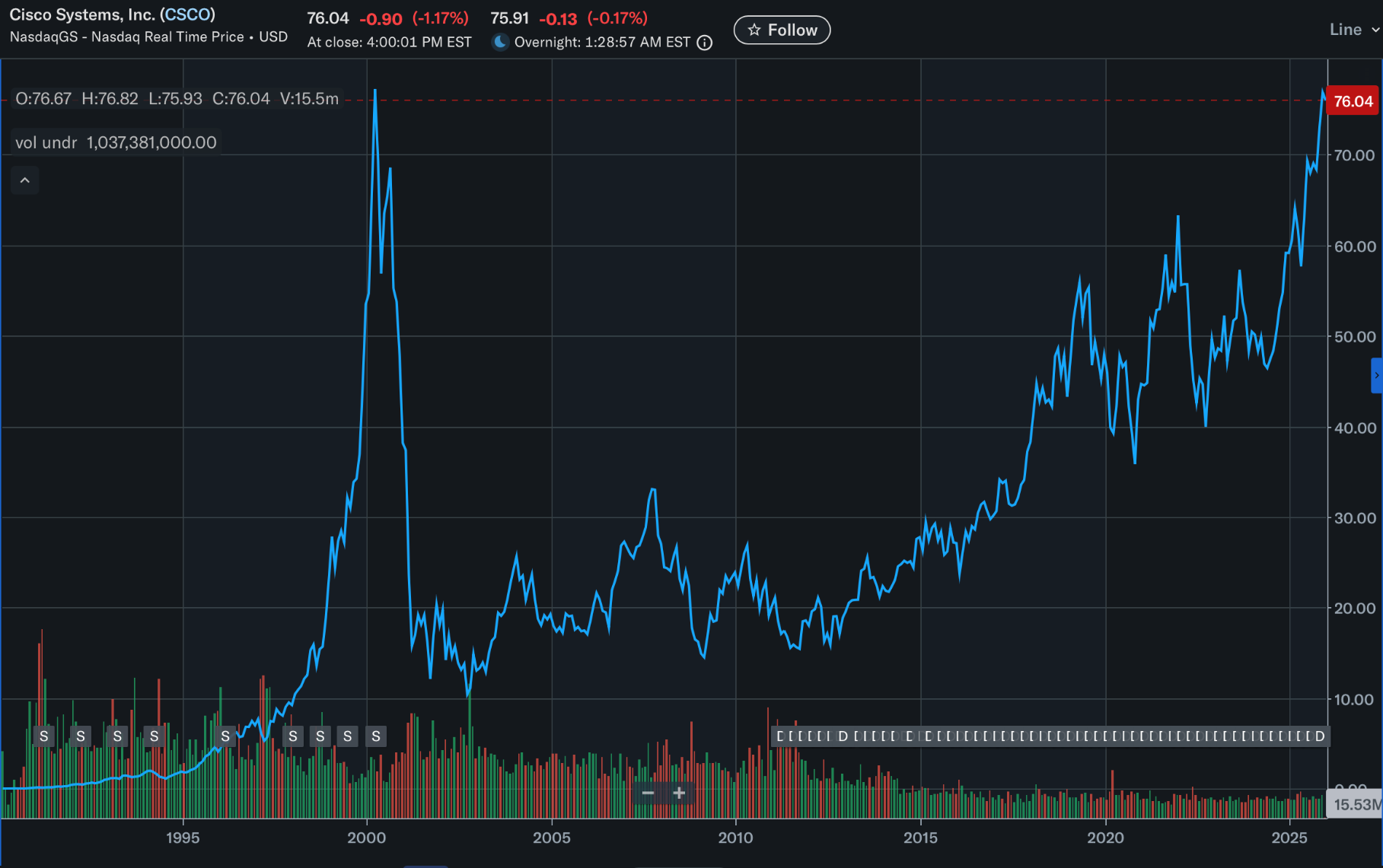
Cisco is on the verge of doing something genuinely absurd.
-
@atomicpoet how does a chart of inflation-adjusted market cap compare? With 25 years of dilution and inflation, they would've crossed the valuation ATH long ago. Maybe around when they started paying dividends in 2011?
@atomicpoet my hunch was completely wrong. They'll need to achieve a market cap of $700B 2025 dollars to reclaim that 2000 peak valuation.
Maybe the accumulated dividends help, but if one bought at $82 in 2000, they'll be waiting quite a while yet to turn that around.
-
Cisco is on the verge of doing something genuinely absurd.
It’s inches away from reclaiming its March 27, 2000 intraday all-time high of 82.00. This is the price level everyone swore would remain frozen in amber forever. Yet here we are.
25 years later, the chart is knocking on the same door it slammed into during the dot-bomb. If it breaks through, that’s a quarter century of history closing like a tab no one thought would ever get paid.
And the significance is massive.
Cisco was no mere casualty of the dot-com bubble. It was the mascot. The crowned king. At the peak, it briefly became the most valuable company on Earth.
Then gravity kicked in, the bottom fell out, and Cisco lost more than 80% of its value in record time. For years, analysts pointed to Cisco as the archetype of speculative mania. It became shorthand for “brilliant idea, terrible valuation.”
Now, right in the middle of a brand-new hype cycle—the AI gold rush—Cisco is quietly about to remind us all of that ancient trauma.
However, the conditions today are nothing like 2000.
Cisco is no longer the poster boy for speculation. Its forward P/E is roughly 18.72, its PEG is 1.82, and it’s been paying reliable dividends since 2011. You don’t get a 2.16% yield from a company powered by hype. You get that from a slow, heavy, cash-generating machine that investors treat like infrastructure—because that’s what it builds.
Which means we can’t say Cisco’s return to its dot-com high is necessarily a bubble signal. Perhaps it’s fundamentals finally catching up to a price investors placed on it a generation ago.
Thing is, the dot-bomb valuation wasn’t ridiculous because Cisco’s future never materialized. It did materialize. The internet became the foundation of the entire global economy. Everything runs on networks now. Cisco’s hardware is the plumbing of modern civilization.
What investors got wrong wasn’t the future. It was the speed.
The market priced in 25 years of growth and adoption as if the whole thing would happen in 5. The vision was right. The timeline was fantasy.
And that’s why this moment is historic. Is Cisco the canary in the coal mine for yet another AI bubble? Or is it proof that sometimes the world really does move in the direction everyone predicted—but not necessarily on schedule?
If Cisco finally clears 82.00, I don’t think it will be a warning. It will be closure. A full cycle completed.
And the final proof that the dot-com era wasn’t wrong about the internet. It was wrong about how long it would take to turn prophecy into cash flow.
@atomicpoet Reasonable.
However, the AI bubble is still a bubble for exactly the opposite reasons: The technology is a dud. It is worthless for everything except fraud and harassment, and it is buoyed entirely by abject and obvious lies.
Will there still be LLMs around in 20 years?
Sure.And they will be as mediocre as now, and be used mainly for fraud and harassment then too.
-
@atomicpoet my hunch was completely wrong. They'll need to achieve a market cap of $700B 2025 dollars to reclaim that 2000 peak valuation.
Maybe the accumulated dividends help, but if one bought at $82 in 2000, they'll be waiting quite a while yet to turn that around.
@johnefrancis $700B market cap isn’t unfeasible if Cisco’s trailing P/E drifted up to around 68. And, hilariously, that would still be a more rational valuation than Tesla’s ever managed.
Now, I’m not saying Cisco deserves that valuation. I’m not even saying it deserves the ~$300B valuation it has today. Valuations aren’t moral judgements. They’re simply the market’s collective hallucination about what the future might look like.
Could Cisco deliver the ROI implied by a number that large? It’s not impossible. It lives in the same neighbourhood as plausible outcomes. But my preference isn’t to game out cosmic scenarios where all the stars align. I’d rather look at what companies actually do over time—which is still speculation, but at least it’s speculation built on track record instead of astrology. -
Cisco is on the verge of doing something genuinely absurd.
It’s inches away from reclaiming its March 27, 2000 intraday all-time high of 82.00. This is the price level everyone swore would remain frozen in amber forever. Yet here we are.
25 years later, the chart is knocking on the same door it slammed into during the dot-bomb. If it breaks through, that’s a quarter century of history closing like a tab no one thought would ever get paid.
And the significance is massive.
Cisco was no mere casualty of the dot-com bubble. It was the mascot. The crowned king. At the peak, it briefly became the most valuable company on Earth.
Then gravity kicked in, the bottom fell out, and Cisco lost more than 80% of its value in record time. For years, analysts pointed to Cisco as the archetype of speculative mania. It became shorthand for “brilliant idea, terrible valuation.”
Now, right in the middle of a brand-new hype cycle—the AI gold rush—Cisco is quietly about to remind us all of that ancient trauma.
However, the conditions today are nothing like 2000.
Cisco is no longer the poster boy for speculation. Its forward P/E is roughly 18.72, its PEG is 1.82, and it’s been paying reliable dividends since 2011. You don’t get a 2.16% yield from a company powered by hype. You get that from a slow, heavy, cash-generating machine that investors treat like infrastructure—because that’s what it builds.
Which means we can’t say Cisco’s return to its dot-com high is necessarily a bubble signal. Perhaps it’s fundamentals finally catching up to a price investors placed on it a generation ago.
Thing is, the dot-bomb valuation wasn’t ridiculous because Cisco’s future never materialized. It did materialize. The internet became the foundation of the entire global economy. Everything runs on networks now. Cisco’s hardware is the plumbing of modern civilization.
What investors got wrong wasn’t the future. It was the speed.
The market priced in 25 years of growth and adoption as if the whole thing would happen in 5. The vision was right. The timeline was fantasy.
And that’s why this moment is historic. Is Cisco the canary in the coal mine for yet another AI bubble? Or is it proof that sometimes the world really does move in the direction everyone predicted—but not necessarily on schedule?
If Cisco finally clears 82.00, I don’t think it will be a warning. It will be closure. A full cycle completed.
And the final proof that the dot-com era wasn’t wrong about the internet. It was wrong about how long it would take to turn prophecy into cash flow.
@atomicpoet I showed this to a central banker and their response was that this was less-than-terrific analysis given that the US money supply has grown fourfold between 2000 and 2025, so 82 USD now is not really comparable with 82 USD in 2000. If you adjust for inflation, 82 USD in 2025 was worth 43 USD in 2000. So the market's belief in Cisco in 2000 still has not been justified in 2025, at best we're halfway that valuation.
-
@atomicpoet Reasonable.
However, the AI bubble is still a bubble for exactly the opposite reasons: The technology is a dud. It is worthless for everything except fraud and harassment, and it is buoyed entirely by abject and obvious lies.
Will there still be LLMs around in 20 years?
Sure.And they will be as mediocre as now, and be used mainly for fraud and harassment then too.
@androcat So just to be clear, you’re saying that real-time language translation, for example, is worthless and a dud? What about something like DLSS too? -
@atomicpoet I showed this to a central banker and their response was that this was less-than-terrific analysis given that the US money supply has grown fourfold between 2000 and 2025, so 82 USD now is not really comparable with 82 USD in 2000. If you adjust for inflation, 82 USD in 2025 was worth 43 USD in 2000. So the market's belief in Cisco in 2000 still has not been justified in 2025, at best we're halfway that valuation.
Walter van Holst So let me be clear: valuation is never justified. It is almost always driven by sentiment and expectations.
What is objective is the balance sheet. Assets, liabilities, earnings, etc.
So whether Cisco is trading at $40, $80, or $240—that doesn’t change the fact that they’ve made $2.59/share.
Now what price is worthwhile? I don’t know—I don’t set prices.
-
Cisco is on the verge of doing something genuinely absurd.
It’s inches away from reclaiming its March 27, 2000 intraday all-time high of 82.00. This is the price level everyone swore would remain frozen in amber forever. Yet here we are.
25 years later, the chart is knocking on the same door it slammed into during the dot-bomb. If it breaks through, that’s a quarter century of history closing like a tab no one thought would ever get paid.
And the significance is massive.
Cisco was no mere casualty of the dot-com bubble. It was the mascot. The crowned king. At the peak, it briefly became the most valuable company on Earth.
Then gravity kicked in, the bottom fell out, and Cisco lost more than 80% of its value in record time. For years, analysts pointed to Cisco as the archetype of speculative mania. It became shorthand for “brilliant idea, terrible valuation.”
Now, right in the middle of a brand-new hype cycle—the AI gold rush—Cisco is quietly about to remind us all of that ancient trauma.
However, the conditions today are nothing like 2000.
Cisco is no longer the poster boy for speculation. Its forward P/E is roughly 18.72, its PEG is 1.82, and it’s been paying reliable dividends since 2011. You don’t get a 2.16% yield from a company powered by hype. You get that from a slow, heavy, cash-generating machine that investors treat like infrastructure—because that’s what it builds.
Which means we can’t say Cisco’s return to its dot-com high is necessarily a bubble signal. Perhaps it’s fundamentals finally catching up to a price investors placed on it a generation ago.
Thing is, the dot-bomb valuation wasn’t ridiculous because Cisco’s future never materialized. It did materialize. The internet became the foundation of the entire global economy. Everything runs on networks now. Cisco’s hardware is the plumbing of modern civilization.
What investors got wrong wasn’t the future. It was the speed.
The market priced in 25 years of growth and adoption as if the whole thing would happen in 5. The vision was right. The timeline was fantasy.
And that’s why this moment is historic. Is Cisco the canary in the coal mine for yet another AI bubble? Or is it proof that sometimes the world really does move in the direction everyone predicted—but not necessarily on schedule?
If Cisco finally clears 82.00, I don’t think it will be a warning. It will be closure. A full cycle completed.
And the final proof that the dot-com era wasn’t wrong about the internet. It was wrong about how long it would take to turn prophecy into cash flow.
@atomicpoet $82 in 2000 is over $150 today accounting for inflation, so of course nothing of the kind is happening.
-
@atomicpoet $82 in 2000 is over $150 today accounting for inflation, so of course nothing of the kind is happening.
Major Denis Bloodnok Of course there’s lots of nuance. I’m not counting dividends either—because what would $CSCO’s share price be if they didn’t issue them?
I am simply looking at the chart and offering context.

-
Major Denis Bloodnok Of course there’s lots of nuance. I’m not counting dividends either—because what would $CSCO’s share price be if they didn’t issue them?
I am simply looking at the chart and offering context.
@atomicpoet Wrong by a factor of 2 isn't "nuance", it's just wrong. You've worked backwards from the conclusion that AI slop must be good somehow and forced it into this (bogus) story about Cisco.
-
@androcat So just to be clear, you’re saying that real-time language translation, for example, is worthless and a dud? What about something like DLSS too?
@atomicpoet @androcat The AI bubble isn't about fake pixels in videogames, not that I'm wild about that either. You're disingenuously using the term "AI" to mean wildly different things (unsurprising for someone who could write "as a gamer, I’ve had AI opponents in FPS games since the 90s. This isn’t new magic"; utter drivel since those opponents have literally nothing in common with what is being pushed now).
-
@atomicpoet Wrong by a factor of 2 isn't "nuance", it's just wrong. You've worked backwards from the conclusion that AI slop must be good somehow and forced it into this (bogus) story about Cisco.
@denisbloodnok Okay, now you’re being disingenuous because what I’m actually talking about is is Cisco’s fundamentals. -
@atomicpoet @androcat The AI bubble isn't about fake pixels in videogames, not that I'm wild about that either. You're disingenuously using the term "AI" to mean wildly different things (unsurprising for someone who could write "as a gamer, I’ve had AI opponents in FPS games since the 90s. This isn’t new magic"; utter drivel since those opponents have literally nothing in common with what is being pushed now).
@denisbloodnok @androcat I’m using AI to mean AI. The term has always referred to a wide family of techniques, not whatever narrow slice of the field currently frustrates you.
It’s the same reason I don’t define “algorithm” as “that sorting trick social platforms use to juice engagement.” I don’t define technical terms by their most negative cultural associations.
If you prefer semantic drift that narrows the field down to whatever you’re mad about today, that’s your choice. But don’t project that onto me. I’m not here to indulge that. -
@denisbloodnok @androcat I’m using AI to mean AI. The term has always referred to a wide family of techniques, not whatever narrow slice of the field currently frustrates you.
It’s the same reason I don’t define “algorithm” as “that sorting trick social platforms use to juice engagement.” I don’t define technical terms by their most negative cultural associations.
If you prefer semantic drift that narrows the field down to whatever you’re mad about today, that’s your choice. But don’t project that onto me. I’m not here to indulge that.So you are engaging in a shell game.
Anything that is useful is no longer [the thing it has been called for ages], rather now it's "AI" and "has always been called AI".
It's disingenuous to a point where I have to ask: Are you the CEO of a tech firm?
-
So you are engaging in a shell game.
Anything that is useful is no longer [the thing it has been called for ages], rather now it's "AI" and "has always been called AI".
It's disingenuous to a point where I have to ask: Are you the CEO of a tech firm?
@androcat @denisbloodnok Nope—I’m semi-retired.
And the only game I’m playing is “definitions”: use words to mean what they actually mean, not whatever happens to fuel this week’s outrage cycle.
If you want to talk about generative LLMs—not AI as a whole—then just say that. -
@androcat @denisbloodnok Nope—I’m semi-retired.
And the only game I’m playing is “definitions”: use words to mean what they actually mean, not whatever happens to fuel this week’s outrage cycle.
If you want to talk about generative LLMs—not AI as a whole—then just say that.You are not, though.
Also, word meaning isn't "defined" to begin with.
Layfolk call dictionary entries "definitions" because, well, layfolk are ignorant of how dictionaries are made.
Also, you will find no "definition" saying that "machine translation" is defined as "AI".
You're grasping for straws in an extremely obvious manner that tells me you already know you're out of your depth, and you just don't want to admit it.
-
You are not, though.
Also, word meaning isn't "defined" to begin with.
Layfolk call dictionary entries "definitions" because, well, layfolk are ignorant of how dictionaries are made.
Also, you will find no "definition" saying that "machine translation" is defined as "AI".
You're grasping for straws in an extremely obvious manner that tells me you already know you're out of your depth, and you just don't want to admit it.
Androcat Major Denis Bloodnok At this point, I don’t even know what you’re arguing about or what you think we’re competing over. Whatever it is, I’m not in your echo chamber—but have fun.
-
Cisco is on the verge of doing something genuinely absurd.
It’s inches away from reclaiming its March 27, 2000 intraday all-time high of 82.00. This is the price level everyone swore would remain frozen in amber forever. Yet here we are.
25 years later, the chart is knocking on the same door it slammed into during the dot-bomb. If it breaks through, that’s a quarter century of history closing like a tab no one thought would ever get paid.
And the significance is massive.
Cisco was no mere casualty of the dot-com bubble. It was the mascot. The crowned king. At the peak, it briefly became the most valuable company on Earth.
Then gravity kicked in, the bottom fell out, and Cisco lost more than 80% of its value in record time. For years, analysts pointed to Cisco as the archetype of speculative mania. It became shorthand for “brilliant idea, terrible valuation.”
Now, right in the middle of a brand-new hype cycle—the AI gold rush—Cisco is quietly about to remind us all of that ancient trauma.
However, the conditions today are nothing like 2000.
Cisco is no longer the poster boy for speculation. Its forward P/E is roughly 18.72, its PEG is 1.82, and it’s been paying reliable dividends since 2011. You don’t get a 2.16% yield from a company powered by hype. You get that from a slow, heavy, cash-generating machine that investors treat like infrastructure—because that’s what it builds.
Which means we can’t say Cisco’s return to its dot-com high is necessarily a bubble signal. Perhaps it’s fundamentals finally catching up to a price investors placed on it a generation ago.
Thing is, the dot-bomb valuation wasn’t ridiculous because Cisco’s future never materialized. It did materialize. The internet became the foundation of the entire global economy. Everything runs on networks now. Cisco’s hardware is the plumbing of modern civilization.
What investors got wrong wasn’t the future. It was the speed.
The market priced in 25 years of growth and adoption as if the whole thing would happen in 5. The vision was right. The timeline was fantasy.
And that’s why this moment is historic. Is Cisco the canary in the coal mine for yet another AI bubble? Or is it proof that sometimes the world really does move in the direction everyone predicted—but not necessarily on schedule?
If Cisco finally clears 82.00, I don’t think it will be a warning. It will be closure. A full cycle completed.
And the final proof that the dot-com era wasn’t wrong about the internet. It was wrong about how long it would take to turn prophecy into cash flow.
@atomicpoet If we're going to have an Internet, people do actually need routers. If you make good routers at a good price, people will buy them. Routers are real -- and useful -- things.
No one needs things which generate texts which have no basis in truth.
-
@atomicpoet If we're going to have an Internet, people do actually need routers. If you make good routers at a good price, people will buy them. Routers are real -- and useful -- things.
No one needs things which generate texts which have no basis in truth.
@simon_brooke What about transcriptions of audio? Do you believe the world needs that? -
@simon_brooke What about transcriptions of audio? Do you believe the world needs that?
@atomicpoet if they're accurate transcriptions, yes. Trustworthy translations of other languages, or faithful audio readings of texts also have merit.
Untrustworthy, unfaithful, inaccurate? No.
-
@atomicpoet if they're accurate transcriptions, yes. Trustworthy translations of other languages, or faithful audio readings of texts also have merit.
Untrustworthy, unfaithful, inaccurate? No.
Simon Brooke Sounds like the issue isn’t AI itself, it’s AI without accountability. Even if the tech keeps getting better, you still need a human in the loop because a machine, no matter how accurate it gets, can’t take responsibility for the final result.
In practice, AI-driven audio transcription is useful. You just need someone to proofread and sign off on the output.