Better don’t give martials any weapons and casters no spellcasting then…
-
Thats not a real opinion that people have is it?
I’ve seen some crazy takes on Sneak Attack, it wouldn’t surprise me if this happened at least once in the entirety of our existence.
Something about rolling a bunch of damage dice without expending resources really makes some people uncomfortable. They see the Paladin and the Sorcerer expending spell slots, the Fighter only having one Action Surge, etc… and come to the conclusion that the Rogue is inherently broken.
-
Thats not a real opinion that people have is it?
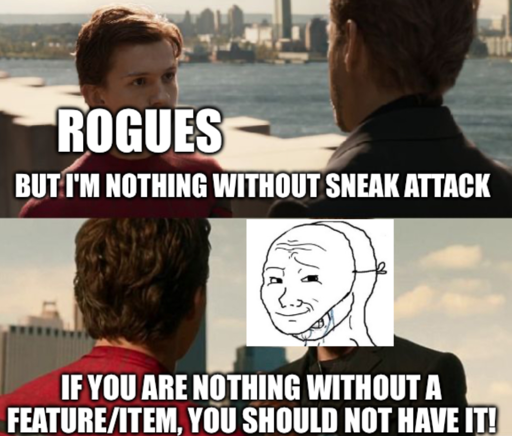
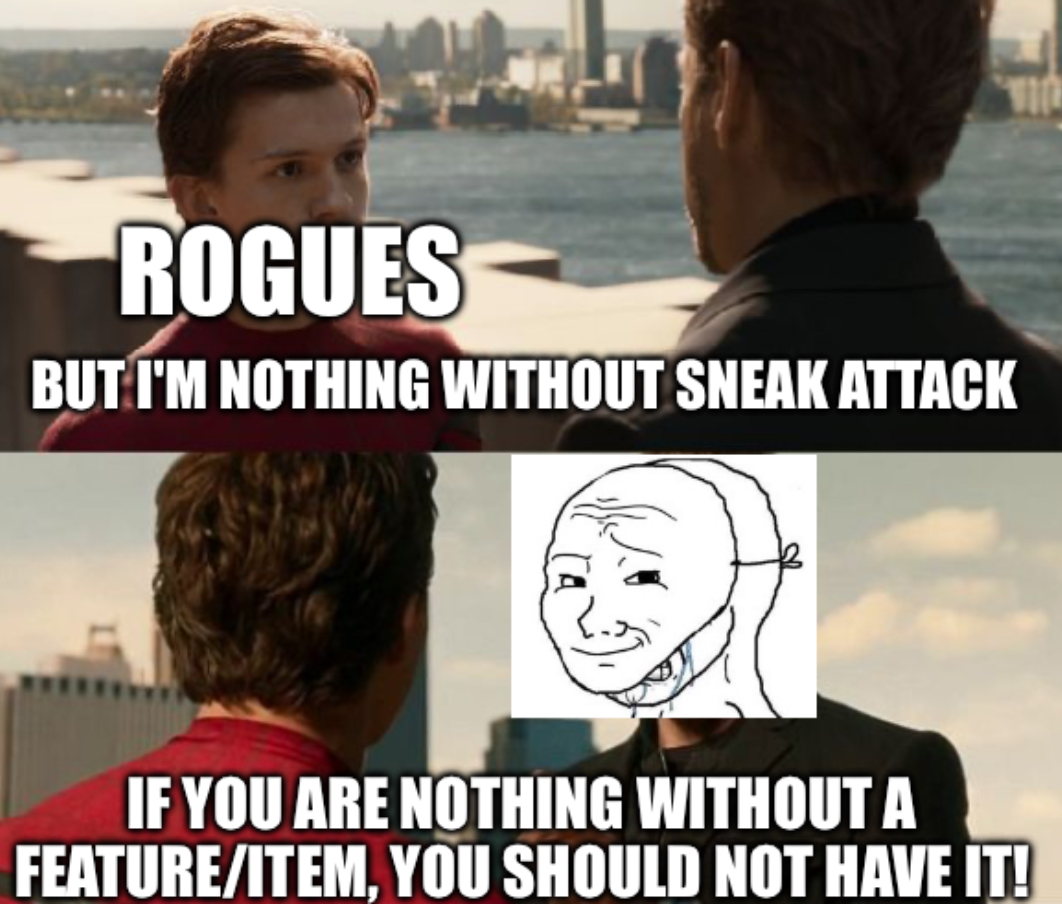
Not in my presence at least. I’m moreso mocking the meme format, as people keep using it whenever someone brings up that their build only works with thing x. I’ve seen it with free feats, smites, 1 level dips, specific feats, magic items, …
Some of those takes were reasonable. Some were not. And while the format was made to criticise overreliance on one thing, I feel like it’s sometimes used too easily. Relying on an abilities is not bad in itself. Some builds only work because of abilities. And while it’s fair to bring up that it’s a bit one dimensional, that doesn’t invalidate the build.
-
This post did not contain any content.
I once played with a DM that strictly ruled that rogues didn’t get a sneak attack bonus unless I was in stealth and undetected by the enemy. (As he said its in the name: SNEAK attack)
I brought up I could probably make that still work with a bow and I was immediately preemptively banned from using ranged weapons lol.
That was a frustrating game.
-
I once played with a DM that strictly ruled that rogues didn’t get a sneak attack bonus unless I was in stealth and undetected by the enemy. (As he said its in the name: SNEAK attack)
I brought up I could probably make that still work with a bow and I was immediately preemptively banned from using ranged weapons lol.
That was a frustrating game.
Did the DM just not like Rogues or were they new to DnD?
-
Did the DM just not like Rogues or were they new to DnD?
To me it sounds just like AD&D 2e rules, in which the ability was called “Backstabbing.”
-
Not in my presence at least. I’m moreso mocking the meme format, as people keep using it whenever someone brings up that their build only works with thing x. I’ve seen it with free feats, smites, 1 level dips, specific feats, magic items, …
Some of those takes were reasonable. Some were not. And while the format was made to criticise overreliance on one thing, I feel like it’s sometimes used too easily. Relying on an abilities is not bad in itself. Some builds only work because of abilities. And while it’s fair to bring up that it’s a bit one dimensional, that doesn’t invalidate the build.
Specialization is good, because when everybody in the party is good at one narrow field we all get to take turns doing cool things. If you make a character that’s good at everything, nobody else gets to do anything.
-
This post did not contain any content.
I had a dm once say he was thinking about saying no about my rogue’s “I shoot, move, bonus action hide around the corner” loop. But then he said he realized if he said no, my character would suck and it’d be no fun.
I think that was the right call.
-
I had a dm once say he was thinking about saying no about my rogue’s “I shoot, move, bonus action hide around the corner” loop. But then he said he realized if he said no, my character would suck and it’d be no fun.
I think that was the right call.
Very much this. It even feels very “rogueish” to employ that strategy and it’s far from broken, so I don’t see why you would ban it.
-
Specialization is good, because when everybody in the party is good at one narrow field we all get to take turns doing cool things. If you make a character that’s good at everything, nobody else gets to do anything.
This as well. Because while a more diverse set of abilities would be cool, if you make it too diverse, everyone suddenly becomes a jack of all trades, master of many and that feels boring.
-
Specialization is good, because when everybody in the party is good at one narrow field we all get to take turns doing cool things. If you make a character that’s good at everything, nobody else gets to do anything.
Specialization is good, because when everybody in the party is good at one narrow field we all get to take turns doing cool things.
This is the premise behind Konosuba.
The party leader is a generalist adventurer and everyone else hyper specializes: max CON 0 DEX tank, EXPLOSION wizard, and cleric with a wisdom dump stat.
-
I once played with a DM that strictly ruled that rogues didn’t get a sneak attack bonus unless I was in stealth and undetected by the enemy. (As he said its in the name: SNEAK attack)
I brought up I could probably make that still work with a bow and I was immediately preemptively banned from using ranged weapons lol.
That was a frustrating game.
In one campaign my DM said that the risk versus reward balance was off when using attack from hidden, move, hide each round on my Halfling Arcane Trickster. I countered that scenario was the reason I picked Halfling, and otherwise I would have been an Elf. He let me give up a cool elven made ranged weapon in an arcane ritual to permanently race change to Elf. I then proceeded to use Flanking to attack with super-advantage from Elven Accuracy, using Booming Blade. I followed up with Cunning Action Disengage if the target wasn’t dead. It had the appearance of risk because it was a melee attack, but it was almost as safe as when I was hiding.
-
I had a dm once say he was thinking about saying no about my rogue’s “I shoot, move, bonus action hide around the corner” loop. But then he said he realized if he said no, my character would suck and it’d be no fun.
I think that was the right call.
Based on the other comments, some DMs seem to have an issue with that. Did they give a reason? I am extremely confused because I’m pretty sure that’s not just the archetype, but also just RAW for rogue. Is there some ambiguity in the wording of the class that I’m just missing?
-
I once played with a DM that strictly ruled that rogues didn’t get a sneak attack bonus unless I was in stealth and undetected by the enemy. (As he said its in the name: SNEAK attack)
I brought up I could probably make that still work with a bow and I was immediately preemptively banned from using ranged weapons lol.
That was a frustrating game.
I’ve been hearing about DM’s complaining about Rogues SA since 3.x days. These are the same guys who (allegedly) thought the monk was more powerful that the sorcerer because the monk’s chart had so many more columns and class features.
Why did you even play with this guy?
-
Based on the other comments, some DMs seem to have an issue with that. Did they give a reason? I am extremely confused because I’m pretty sure that’s not just the archetype, but also just RAW for rogue. Is there some ambiguity in the wording of the class that I’m just missing?
“it seems silly that you can just go around the corner and suddenly you’re hidden. They know you’re there”
This was rebutted with “they know I’m somewhere over there, but not exactly where or when I’m going to pop out. I’m a 7th level rogue, I’m sure I have tricks you and I can’t even think of”.
Sometimes people get like selectively simulationist. They’ll ignore most of the game’s gamey bits (inventory management, hit points and recovery, magic) but some things throw them off. Usually things that are closer to lived reality. For example, someone having no problem with a wizard hypnotizing an entire room, but balking at a fighter climbing a tall fence.
There was also: “It seems like a lot of damage…”
“I’m pretty sure rogue is balanced around doing sneak attack almost every round. The fighter gets multiple attacks, but I don’t. Almost every other class gets a resource to burn like spell points or ki points or superiority dice. I have nothing. All I do is sneak attack. Without it, I’m a particularly accurate peasant that can run away real good. And I still miss about a quarter of the time, which means my whole turn accomplishes nothing”
I wonder if the DMG or something published expected damage per round or per encounter somewhere.
-
“it seems silly that you can just go around the corner and suddenly you’re hidden. They know you’re there”
This was rebutted with “they know I’m somewhere over there, but not exactly where or when I’m going to pop out. I’m a 7th level rogue, I’m sure I have tricks you and I can’t even think of”.
Sometimes people get like selectively simulationist. They’ll ignore most of the game’s gamey bits (inventory management, hit points and recovery, magic) but some things throw them off. Usually things that are closer to lived reality. For example, someone having no problem with a wizard hypnotizing an entire room, but balking at a fighter climbing a tall fence.
There was also: “It seems like a lot of damage…”
“I’m pretty sure rogue is balanced around doing sneak attack almost every round. The fighter gets multiple attacks, but I don’t. Almost every other class gets a resource to burn like spell points or ki points or superiority dice. I have nothing. All I do is sneak attack. Without it, I’m a particularly accurate peasant that can run away real good. And I still miss about a quarter of the time, which means my whole turn accomplishes nothing”
I wonder if the DMG or something published expected damage per round or per encounter somewhere.
“Selectively simulationist” is a great way to put it. I think everyone falls victim to that from time to time and I’m definitely stealing your turn of phrase.
-
Based on the other comments, some DMs seem to have an issue with that. Did they give a reason? I am extremely confused because I’m pretty sure that’s not just the archetype, but also just RAW for rogue. Is there some ambiguity in the wording of the class that I’m just missing?
Our group found the rogue took as long to take their turn as everyone else put together, but we never disallowed anything, we just stopped picking rogues as much. More experienced groups could probably handle the rolls quickly.
-
“it seems silly that you can just go around the corner and suddenly you’re hidden. They know you’re there”
This was rebutted with “they know I’m somewhere over there, but not exactly where or when I’m going to pop out. I’m a 7th level rogue, I’m sure I have tricks you and I can’t even think of”.
Sometimes people get like selectively simulationist. They’ll ignore most of the game’s gamey bits (inventory management, hit points and recovery, magic) but some things throw them off. Usually things that are closer to lived reality. For example, someone having no problem with a wizard hypnotizing an entire room, but balking at a fighter climbing a tall fence.
There was also: “It seems like a lot of damage…”
“I’m pretty sure rogue is balanced around doing sneak attack almost every round. The fighter gets multiple attacks, but I don’t. Almost every other class gets a resource to burn like spell points or ki points or superiority dice. I have nothing. All I do is sneak attack. Without it, I’m a particularly accurate peasant that can run away real good. And I still miss about a quarter of the time, which means my whole turn accomplishes nothing”
I wonder if the DMG or something published expected damage per round or per encounter somewhere.
I actually don’t like the “magic exist so fuck simulatiounism” reasoning, since it implies that as soon as magic exists, any rational explanations are off the table. I generally prefer to establish what can and can’t be done, so we have as baseline for what’s possible. Otherwise you quickly loose consistency. Martials should be able to do more than regular people in our world, but there should be guidelines on what they can do.
Yes the game is not a simulation. But I prefer using examples aside from magic. Magic is not simplification for game purposes, magic is part of the setting. Things like HP, the turn order and armor class vs. saving throws generally work better as comparisons.
-
In one campaign my DM said that the risk versus reward balance was off when using attack from hidden, move, hide each round on my Halfling Arcane Trickster. I countered that scenario was the reason I picked Halfling, and otherwise I would have been an Elf. He let me give up a cool elven made ranged weapon in an arcane ritual to permanently race change to Elf. I then proceeded to use Flanking to attack with super-advantage from Elven Accuracy, using Booming Blade. I followed up with Cunning Action Disengage if the target wasn’t dead. It had the appearance of risk because it was a melee attack, but it was almost as safe as when I was hiding.
I think people overestimate what hiding can do for you. Hiding does not immediately shield you from harm. You can’t hide if there’s nothing to hide behind. If an enemy walks around your cover, even the best stealth roll in the whole world won’t keep you hidden.
How did the DM react to your new strategy?
-
I actually don’t like the “magic exist so fuck simulatiounism” reasoning, since it implies that as soon as magic exists, any rational explanations are off the table. I generally prefer to establish what can and can’t be done, so we have as baseline for what’s possible. Otherwise you quickly loose consistency. Martials should be able to do more than regular people in our world, but there should be guidelines on what they can do.
Yes the game is not a simulation. But I prefer using examples aside from magic. Magic is not simplification for game purposes, magic is part of the setting. Things like HP, the turn order and armor class vs. saving throws generally work better as comparisons.
Well, thankfully I included examples other than magic.
However, I do think trying too hard on “martials should be like real life” easily leads to harsher limitations for them. It’s not always intentional. But when someone says “I want to leap 15 feet over the chasm” some people get all “you can’t do that! I can barely jump five feet and I’m athletic (they’re not)” and you have a whole digression where someone looks up human records and then argues about if 16 strength is really Olympic class and what about all your equipment and blah blah blah.
It’s much rarer for that kind of argument to come up with wizard types, in my experience.
Clearer rules up front help, though I feel like half of DND players have never read the rules.
-
Based on the other comments, some DMs seem to have an issue with that. Did they give a reason? I am extremely confused because I’m pretty sure that’s not just the archetype, but also just RAW for rogue. Is there some ambiguity in the wording of the class that I’m just missing?
It’s nearly their entire fucking power budget, and they’re not even a great class!


Hello! It looks like you're interested in this conversation, but you don't have an account yet.
Getting fed up of having to scroll through the same posts each visit? When you register for an account, you'll always come back to exactly where you were before, and choose to be notified of new replies (either via email, or push notification). You'll also be able to save bookmarks and upvote posts to show your appreciation to other community members.
With your input, this post could be even better 💗
Register Login