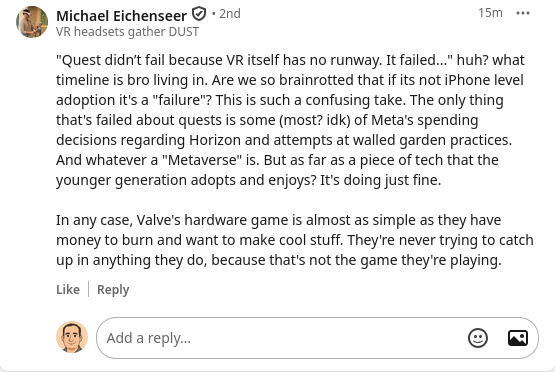
VR industry people really don’t like it when I tell them that Meta failed with the Quest.
-
VR industry people really don’t like it when I tell them that Meta failed with the Quest.
But it’s true. It’s not that the Quest didn’t sell well. It’s that it failed to be what Meta needed it to be.
Meta didn’t buy Oculus to make a fun gaming peripheral. They bet tens of billions on Oculus becoming “the next iPhone”—the next universal computing platform after smartphones. They needed VR to replace your monitor, your TV, your phone, your laptop, your workplace, and your social life. They needed a new operating system they controlled from top to bottom, a new app store they took a cut from, a new identity layer they could own, and a new digital world they could monetize forever.
That was the business case. Not Beat Saber. Not fitness apps. Not a fun toy for teens.
The problem is that VR was never in a position to become that universal platform. Smartphones solved immediate, essential problems and sat in your pocket, always on, always available. VR solves one thing—immersion—and requires you to strap a device to your face.
That’s great for games, but it’s never going to be the foundation of daily life. Meta knew this, but they couldn’t admit it. They had already sunk so much capital, talent, and corporate identity into “the metaverse” that they had to hype it as inevitable. Virtual offices. Virtual cities. Virtual meetings. Virtual everything. They sold inevitability because reality wasn’t compelling enough.
The result was a hype cycle that spiraled out of control. Meta spent over $36 billion building a future no one asked for. The hardware remained heavy, isolating, battery-starved, and full of friction.
Horizon Worlds wasn’t a digital civilization—it was a ghost town. And once Meta framed VR as “the next internet,” they trapped themselves. You can’t quietly walk back a moonshot after declaring it the future of the human race. So they doubled down, again and again, until expectations collapsed under the weight of their own ambition.
But this isn’t a failure of VR. It’s a failure of Meta’s narrative. VR didn’t need to be the next iPhone. It just needed to be good at what it’s good at. Meta tried to universalize a niche technology and punished it for refusing to become something it was never meant to be.
Meanwhile, Valve is playing an entirely different game. People keep saying they “have money to burn,” but that undersells what’s actually happening. Steam is a revenue supernova with a tiny headcount. Their hardware isn’t a rich guy’s hobby—it’s strategic infrastructure that strengthens the ecosystem. SteamOS, Proton, the Deck, the Index, and now the Frame aren’t attempts to dominate all human computing. They’re ways of making it easier for people like me to play the games we already own, on more screens, with less friction.
Meta needed VR to become the world’s operating system. Valve just needs it to be a great way to play games.
Which of those goals sounds more achievable?
That’s why I think Valve will win more than people expect. Meta bet on a civilization-shifting platform revolution that never came. Valve is building something smaller, smarter, and more grounded—and in the process, they’re giving VR the one thing it always needed but never got: a reason for actual players to care.