I've been using Lilypond to write musical notation with code, and here I write about how to get a convenient, smooth experience while writing that code in Neovim!
-
I've been using Lilypond to write musical notation with code, and here I write about how to get a convenient, smooth experience while writing that code in Neovim!
I'm definitely planning to stick with this, and I'll be writing about some more fun things to do with Lilypond soon.
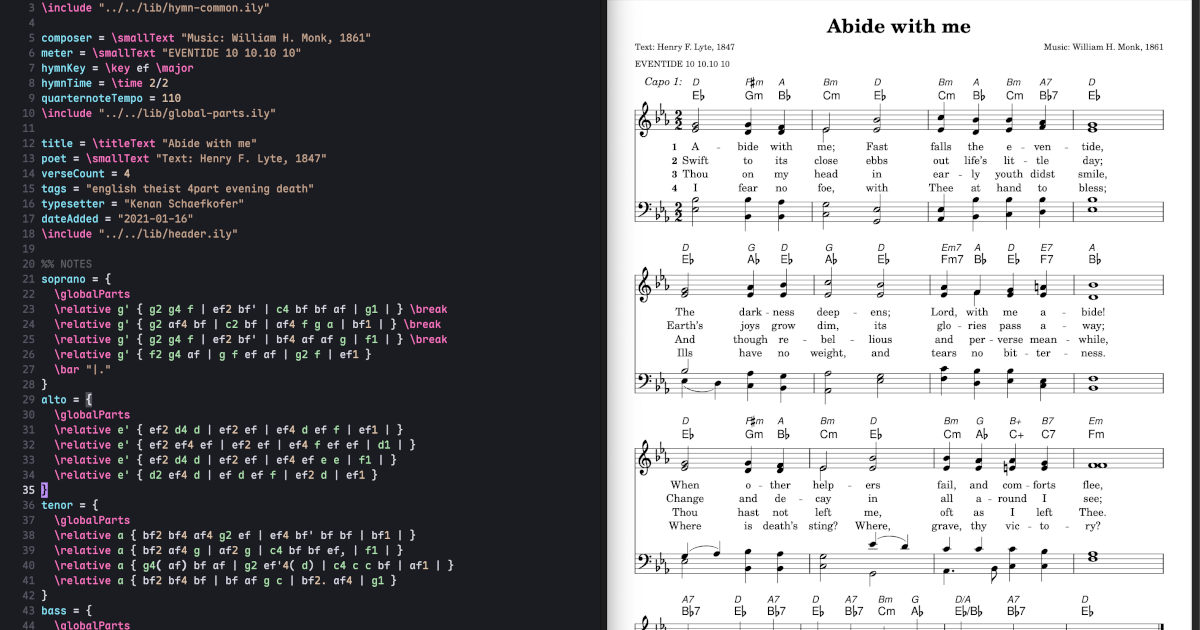
Friendly Lilypond with Neovim & Audacity
I made a nice setup to write Lilypond scores in Neovim, while still being able to conveniently view and listen to them

(reillyspitzfaden.com)
#Lilypond #Composition #ClassicalMusic #ContemporaryClassical #Neovim #MIDI #Audio #Audacity
@reillypascal I had a program in the mid-to-late 1980s called Music Construction Set, and haven't composed much since. This post kinda makes me want to drop everything and dive back in.
-
@reillypascal I had a program in the mid-to-late 1980s called Music Construction Set, and haven't composed much since. This post kinda makes me want to drop everything and dive back in.
@ross I had to look it up, but sounds like a cool program. This is also reminding me that there was another popular score writer from the era called SCORE (https://en.wikipedia.org/wiki/SCORE_(software)). Kind of esoteric syntax, but I hear people really liked it and stuck with it long after it was discontinued.
I would definitely go for it with Lilypond! It really is fun, and it's a GNU project, so integration with Emacs is quite good, and you can extend it with Scheme/Guile.
-
@ross I had to look it up, but sounds like a cool program. This is also reminding me that there was another popular score writer from the era called SCORE (https://en.wikipedia.org/wiki/SCORE_(software)). Kind of esoteric syntax, but I hear people really liked it and stuck with it long after it was discontinued.
I would definitely go for it with Lilypond! It really is fun, and it's a GNU project, so integration with Emacs is quite good, and you can extend it with Scheme/Guile.
@reillypascal I was fighting the urge, and then you had to drop an Emacs and a Scheme on me. How can I resist?
-
@reillypascal I was fighting the urge, and then you had to drop an Emacs and a Scheme on me. How can I resist?
@ross thought you might say that! I've been learning Scheme for this purpose, and it/Lisp really is cool to explore.
-
@ross thought you might say that! I've been learning Scheme for this purpose, and it/Lisp really is cool to explore.
@reillypascal BASIC was my first language and Perl my first paid language, but Scheme was the first where I started to see how to make the others. That one is special.
-
I've been using Lilypond to write musical notation with code, and here I write about how to get a convenient, smooth experience while writing that code in Neovim!
I'm definitely planning to stick with this, and I'll be writing about some more fun things to do with Lilypond soon.
Friendly Lilypond with Neovim & Audacity
I made a nice setup to write Lilypond scores in Neovim, while still being able to conveniently view and listen to them
(reillyspitzfaden.com)
#Lilypond #Composition #ClassicalMusic #ContemporaryClassical #Neovim #MIDI #Audio #Audacity
@reillypascal Two opinionated LilyPond tips:
1. Use \language "english" at the top of each file so you can type note names as cs/cf/css/cff. Unless you really like typing Dutch note names (cis/ces/cisis/ceses).
2. The manual recommends \relative mode but I'm not a fan. I prefer "absolute" mode (the default one), and use \transpose to deal with unwieldy octaves. -
@reillypascal Two opinionated LilyPond tips:
1. Use \language "english" at the top of each file so you can type note names as cs/cf/css/cff. Unless you really like typing Dutch note names (cis/ces/cisis/ceses).
2. The manual recommends \relative mode but I'm not a fan. I prefer "absolute" mode (the default one), and use \transpose to deal with unwieldy octaves.@ho thanks for the tips! For the note names, I ended up switching to that out of necessity — I was setting up 8th/quarter tones (https://codeberg.org/reillypascal/forget/src/branch/main/include/eighth-quarter-tones.ly) and I didn't want to try researching what 8th tones “should” be in Dutch.
For the transposition, is there a difference between typing e.g., `\fixed c'` and using `\transpose`? I had been trying out `\fixed` plus a reference octave.
-
@ho thanks for the tips! For the note names, I ended up switching to that out of necessity — I was setting up 8th/quarter tones (https://codeberg.org/reillypascal/forget/src/branch/main/include/eighth-quarter-tones.ly) and I didn't want to try researching what 8th tones “should” be in Dutch.
For the transposition, is there a difference between typing e.g., `\fixed c'` and using `\transpose`? I had been trying out `\fixed` plus a reference octave.
@reillypascal Oh huh, \fixed must be a newer feature. Should be the same.
-
@reillypascal Oh huh, \fixed must be a newer feature. Should be the same.
@ho oh cool, good to know!
-
I've been using Lilypond to write musical notation with code, and here I write about how to get a convenient, smooth experience while writing that code in Neovim!
I'm definitely planning to stick with this, and I'll be writing about some more fun things to do with Lilypond soon.
Friendly Lilypond with Neovim & Audacity
I made a nice setup to write Lilypond scores in Neovim, while still being able to conveniently view and listen to them
(reillyspitzfaden.com)
#Lilypond #Composition #ClassicalMusic #ContemporaryClassical #Neovim #MIDI #Audio #Audacity
@reillypascal I neither use NeoVIM nor Lilypond or usually do much of Computer generated Music, but must read the whole article in yesterday, just out of joy, how well written it is.
Your steps were understandable and comprehensible to me and I also learned a bit.
Just want say, what you are doing is important and good. Thanks for sharing! -
@reillypascal I neither use NeoVIM nor Lilypond or usually do much of Computer generated Music, but must read the whole article in yesterday, just out of joy, how well written it is.
Your steps were understandable and comprehensible to me and I also learned a bit.
Just want say, what you are doing is important and good. Thanks for sharing!@noisio aww that's so nice! I really appreciate the feedback — this is all stuff I'm going for with my blog, so it's great to hear it's working.