TL;DR Most EV batteries will last longer than the cars they’re in.
-
This also means that buying a used EV is perfectly fine. If the used car is „younger“ than 5-7 years, the battery will be fine for years to come.
„How long do EV batteries last?
The average lifespan of EV batteries will be around 13 years or more based on observed degradation rates.“
@jwildeboer Would this not mean that EVs could have a longer useful life compared to ICE Vehicles? I get that inverters and such high power components probably age more than the electric motor.
-
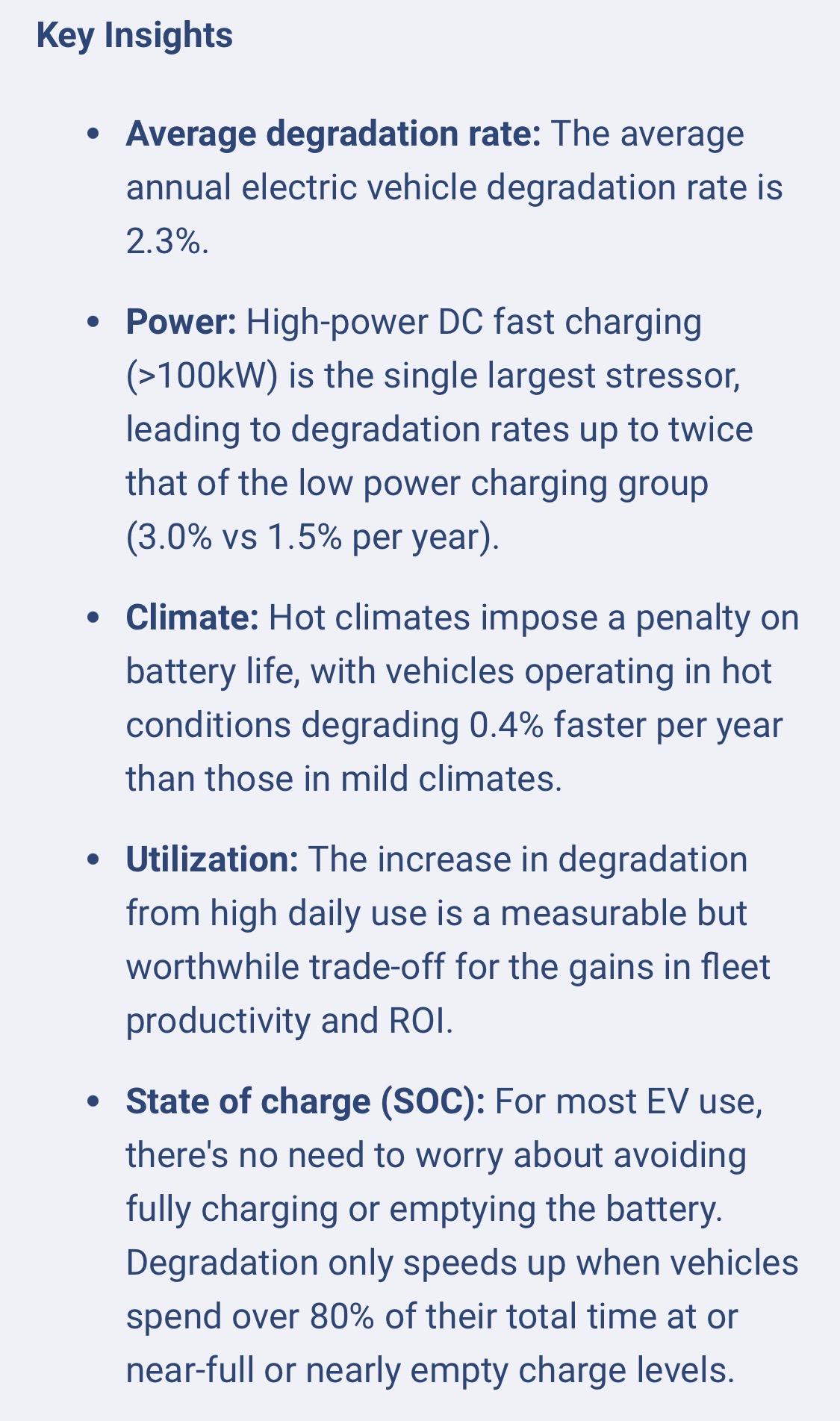
TL;DR Most EV batteries will last longer than the cars they’re in. Battery degradation is at better (meaning: lower) rates than expected. Slow charging is better. Drive EV and don’t worry about your battery.
„Our 2025 analysis of over 22,700 electric vehicles, covering 21 different vehicle models, confirms that overall, modern EV batteries are robust and built to last beyond a typical vehicle’s service life.“
EV Battery Health: Key Findings from 22,700 Vehicle Data Analysis | Geotab
Analysis of electric vehicle battery health of 22K+ EVs reveals a 2.3% average battery degradation rate. High-power DC fast charging is the top risk factor.
Geotab (www.geotab.com)
@jwildeboer empirically my 5 year old Kia e-Niro shows essentially no visible degradation at all. Last summer I was still getting 280-300 miles range on mixed driving scenarios, which is over the official stated 270 mile range at new

The only common cars where you had significant degradation were first generation nissan leaf which lacked any battery thermal management and a small battery to begin with. I wouldn't hesitate to buy another secondhand EV - much less to worry about than a secondhand ICE with countless moving parts to go wrong.
-
TL;DR Most EV batteries will last longer than the cars they’re in. Battery degradation is at better (meaning: lower) rates than expected. Slow charging is better. Drive EV and don’t worry about your battery.
„Our 2025 analysis of over 22,700 electric vehicles, covering 21 different vehicle models, confirms that overall, modern EV batteries are robust and built to last beyond a typical vehicle’s service life.“
EV Battery Health: Key Findings from 22,700 Vehicle Data Analysis | Geotab
Analysis of electric vehicle battery health of 22K+ EVs reveals a 2.3% average battery degradation rate. High-power DC fast charging is the top risk factor.
Geotab (www.geotab.com)
@jwildeboer huh, so that means a car you leave charged up at home and use maybe once a week or less will degrade its battery fast.
-
TL;DR Most EV batteries will last longer than the cars they’re in. Battery degradation is at better (meaning: lower) rates than expected. Slow charging is better. Drive EV and don’t worry about your battery.
„Our 2025 analysis of over 22,700 electric vehicles, covering 21 different vehicle models, confirms that overall, modern EV batteries are robust and built to last beyond a typical vehicle’s service life.“
EV Battery Health: Key Findings from 22,700 Vehicle Data Analysis | Geotab
Analysis of electric vehicle battery health of 22K+ EVs reveals a 2.3% average battery degradation rate. High-power DC fast charging is the top risk factor.
Geotab (www.geotab.com)
@jwildeboer The early Nissan Leaf certainly didn't do this well, but the article is talking about newer EVs. I sold my 2011 Leaf in 2019, but had replaced the battery in 2017. #nissanleaf
When my two subsequent EVs (Tesla Model 3 then Hyundai Kona) get down to the maximum fully charged range of the Leaf (70 miles), I feel like they're almost empty. I charge to 80%, but I'm retired and now live on a small island, so range isn't a big deal like it sometimes was in California.
-
@jwildeboer huh, so that means a car you leave charged up at home and use maybe once a week or less will degrade its battery fast.
@mirabilos The BMS (Battery Management System) in modern EVs is smart enough to counter that by not going above 80%. It's still a good idea to regularly bring down the charge to below 50% at least, though.
-
@mirabilos The BMS (Battery Management System) in modern EVs is smart enough to counter that by not going above 80%. It's still a good idea to regularly bring down the charge to below 50% at least, though.
@jwildeboer that just means one has to buy a battery that’s 5/4 as large as one really needs

-
@jwildeboer
Therefore, the batteries will be enshittified to last the duration of the warranty, then degrade swiftly.
No automaker wants their cars to last forever.The cars will degrade in any case. Particularly in areas with winter, salt will cause an ongoing rust problem.
Not to mention that the car computers' wirings will not last forever, either.
-
TL;DR Most EV batteries will last longer than the cars they’re in. Battery degradation is at better (meaning: lower) rates than expected. Slow charging is better. Drive EV and don’t worry about your battery.
„Our 2025 analysis of over 22,700 electric vehicles, covering 21 different vehicle models, confirms that overall, modern EV batteries are robust and built to last beyond a typical vehicle’s service life.“
EV Battery Health: Key Findings from 22,700 Vehicle Data Analysis | Geotab
Analysis of electric vehicle battery health of 22K+ EVs reveals a 2.3% average battery degradation rate. High-power DC fast charging is the top risk factor.
Geotab (www.geotab.com)
Good news…
-
@bob_zim I think I do recall that, actually, but to be fair, anyone who ever tried to keep a ghetto blaster going on NiMH D-cells knows that was doomed from the start.
@jpaskaruk @bob_zim @jwildeboer my boomnox had 8 and drained them pretty fast. Lol
-
@dalias many newer cars manufactured in the past 20+ years will not make it to 25 years due to electronics failing (capacitors and mosfets are typical candidates), regardless of being powered by ICE or EV.
@jwildeboer See: "atrociously bad quality of cars". This wouldn't be a problem if swapping out the electronics were trivial, but when you have an intentionally locked-down shit Android device on wheels rather than a proper car...
-
TL;DR Most EV batteries will last longer than the cars they’re in. Battery degradation is at better (meaning: lower) rates than expected. Slow charging is better. Drive EV and don’t worry about your battery.
„Our 2025 analysis of over 22,700 electric vehicles, covering 21 different vehicle models, confirms that overall, modern EV batteries are robust and built to last beyond a typical vehicle’s service life.“
EV Battery Health: Key Findings from 22,700 Vehicle Data Analysis | Geotab
Analysis of electric vehicle battery health of 22K+ EVs reveals a 2.3% average battery degradation rate. High-power DC fast charging is the top risk factor.
Geotab (www.geotab.com)
@jwildeboer What about cold days? We recently had about 3 weeks around -40, usually get about 2 weeks a year below -30 C and months of -20 C. In this climate, must people don't have a garage, and those who do generally don't heat them. Any insight?
-
@jwildeboer yes. Data doesn't go that far.
@renard @jwildeboer battery degradation slows down over the lifetime. Although this probably depends on the chemistry.
BEVs typically have lower maintenance, so I don't see why 20yr can't be matched. If (e.g.) 70% State-of-Health is acceptable 20-years in, i guess it's still a viable car to drive.
However, I'm not sure why "20 years" is a metric to hold up against. Is that primarily a financial consideration? Worded differently: Would you buy younger for the same price?
-
 P Pteryx the Puzzle Secretary shared this topic