Finally taking the plunge and learning Lilypond!
-
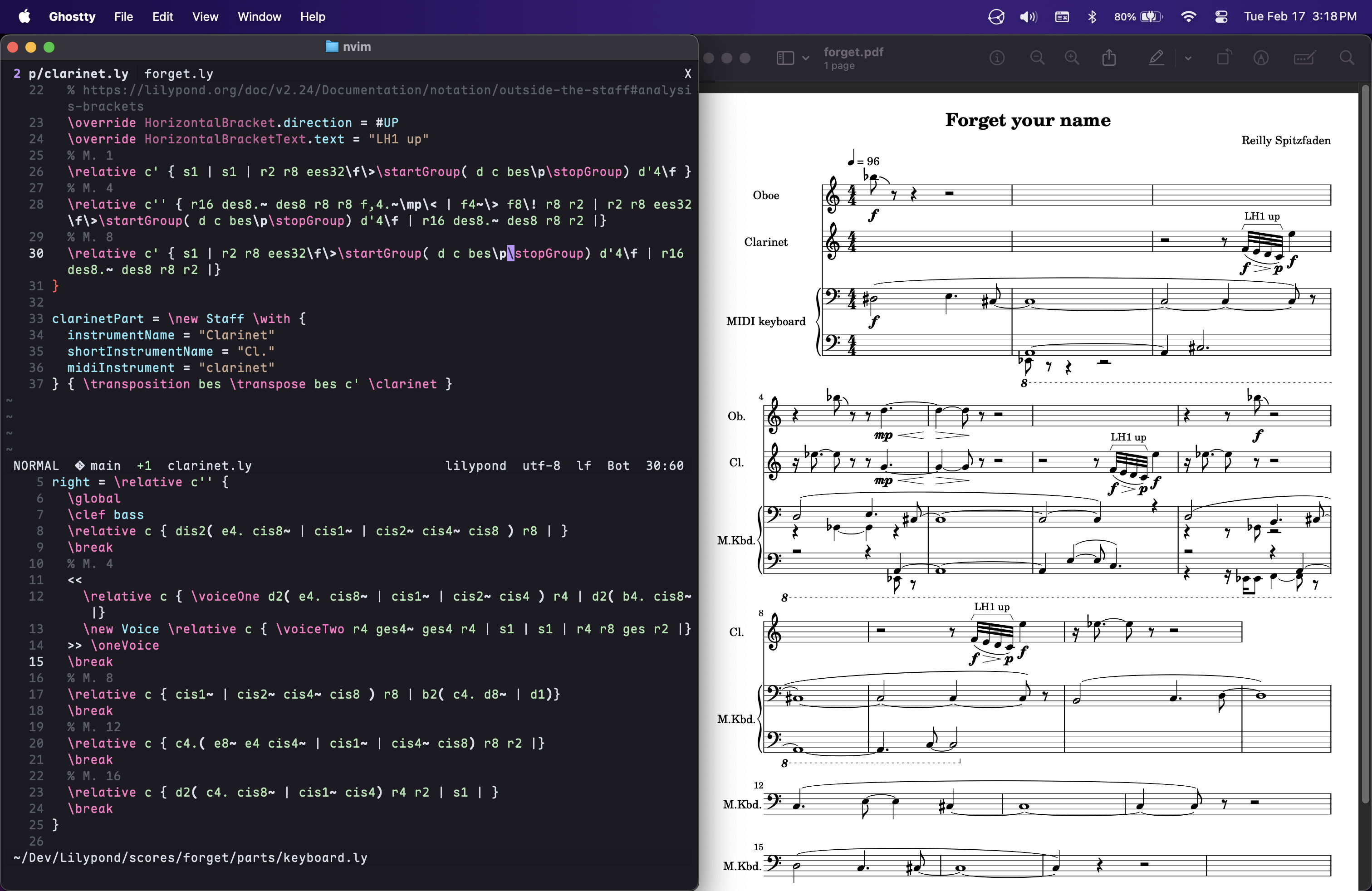
Finally taking the plunge and learning Lilypond! It's kind of like LaTeX for sheet music.
I'd been interested since the Finale debacle, and while Dorico has been nice, I'm finding that in many cases I prefer writing text files to working in a graphical program, so it made sense to give it a go.
#Lilypond #SheetMusic #Composition #Composer #MaxMSP #Neovim
-
Finally taking the plunge and learning Lilypond! It's kind of like LaTeX for sheet music.
I'd been interested since the Finale debacle, and while Dorico has been nice, I'm finding that in many cases I prefer writing text files to working in a graphical program, so it made sense to give it a go.
#Lilypond #SheetMusic #Composition #Composer #MaxMSP #Neovim
While I prefer to bring my own text editor, the dedicated Frescobaldi editor is useful to play MIDI output into a virtual bus, and send that to Max to host some VSTs and my MIDI keyboard performance patch.
#Lilypond #SheetMusic #Composition #Composer #MaxMSP #Neovim
-
While I prefer to bring my own text editor, the dedicated Frescobaldi editor is useful to play MIDI output into a virtual bus, and send that to Max to host some VSTs and my MIDI keyboard performance patch.
#Lilypond #SheetMusic #Composition #Composer #MaxMSP #Neovim
There's a nice plugin to write sheet music in Lilypond right from Neovim: https://github.com/martineausimon/nvim-lilypond-suite
I can get syntax highlighting, error-checking, autocompletion from a dictionary, etc., and it has keybindings to render/open the PDF score.
-
Finally taking the plunge and learning Lilypond! It's kind of like LaTeX for sheet music.
I'd been interested since the Finale debacle, and while Dorico has been nice, I'm finding that in many cases I prefer writing text files to working in a graphical program, so it made sense to give it a go.
#Lilypond #SheetMusic #Composition #Composer #MaxMSP #Neovim
@reillypascal I actually found Finale harder to use than Lilypond, especially when it came to things that you couldn't intuitively figure out with the Finale GUI.
When I needed to look up something, the documentation was this confusing mess of screenshots showing the menus to navigate and the buttons to press.
Lilypond documentation was much more straightforward: here's the term for the thing you want, here's an example of what it looks like, here's the code for that example. Usually I could work the example to fit my needs.
Towards the end of all my classes with sheet music assignments, I was all Lilypond.
-
@reillypascal I actually found Finale harder to use than Lilypond, especially when it came to things that you couldn't intuitively figure out with the Finale GUI.
When I needed to look up something, the documentation was this confusing mess of screenshots showing the menus to navigate and the buttons to press.
Lilypond documentation was much more straightforward: here's the term for the thing you want, here's an example of what it looks like, here's the code for that example. Usually I could work the example to fit my needs.
Towards the end of all my classes with sheet music assignments, I was all Lilypond.
@paul my hope is that I'll have a similar experience. I already like that I can leave comments in my files and fuzzy-search through the folder of files if I forget how I did something — definitely can't do that with a GUI menu!
-
@paul my hope is that I'll have a similar experience. I already like that I can leave comments in my files and fuzzy-search through the folder of files if I forget how I did something — definitely can't do that with a GUI menu!
@reillypascal @paul I use it for everything. Composition, engraving of historical scores. In recent releases the markup language also got way more expressive and "semantic" (\fine instead of \bar "|.", etc.) so its even more fun.
Just a random note on your screenshots, `\relative c'` I find mind-boggling, I am firmly in the `\fixed c'` camp (So I prefer to choose the "primary" octave the voice works in and then use , and ' to move to the neighbouring octaves. \relative c' just always surpises me and is instable if you do edits within a melodic line.
-
@reillypascal @paul I use it for everything. Composition, engraving of historical scores. In recent releases the markup language also got way more expressive and "semantic" (\fine instead of \bar "|.", etc.) so its even more fun.
Just a random note on your screenshots, `\relative c'` I find mind-boggling, I am firmly in the `\fixed c'` camp (So I prefer to choose the "primary" octave the voice works in and then use , and ' to move to the neighbouring octaves. \relative c' just always surpises me and is instable if you do edits within a melodic line.
@kephalos yeah I was running into exactly those issues today, and I think I'll take the suggestion and use `\absolute`.