What if the Mac never existed
-
What if the Mac never existed?
In that alternate timeline, Steve Jobs and Steve Wozniak never founded Apple. Instead, they stayed at Atari, where both were already known for pushing consumer-friendly design in a company that mostly thought like a coin-op manufacturer.
When Atari’s internal hardware ambitions shifted toward the Lorraine project—the early form of what became the Amiga—it’s almost inevitable that Jobs and Wozniak would have gravitated toward it. The Amiga’s philosophy of custom silicon, multimedia flair, and user-accessible creativity fits their instincts far better than Atari’s more conservative console roadmap.
Then comes the real pivot: the 1984 corporate shuffle. Jack Tramiel buys Atari’s consumer division. The Amiga team jumps to Commodore.
In this world, Jobs and Wozniak follow them because staying at Tramiel-run Atari would be impossible. Jobs and Tramiel would mix like gasoline and a flamethrower. So Jobs lands at Commodore just as the Amiga is preparing to launch.
Under Jobs’s influence, the Amiga is still a multimedia beast, but now wrapped in a much more disciplined product vision. Wozniak’s engineering ethos meshes with the Amiga’s custom chipset philosophy, while Jobs pushes for a unified OS experience, a consistent UI, and an ecosystem strategy. The Amiga launches with real marketing muscle, a far clearer identity, and a push toward creative professionals—video, sound, animation—nearly a decade before the real-world desktop-publishing boom.
But Commodore is still Commodore. By 1985, Jobs is clashing with management over long-term strategy, product focus, and the company’s famously chaotic internal politics. He walks. Wozniak stays a bit longer, contributing to refinements of the Amiga chipset before drifting into education and philanthropic engineering projects.
Jobs founds NeXT exactly as he did in real life. High-end workstation. Black magnesium cube. Laser-focused on higher education and advanced software architectures. But NeXT never finds its footing.
By the mid-90s, Commodore is struggling with the transition to PowerPC hardware and a fragmented OS that has become too archaic for the modern internet.
So in 1995, Commodore does the unthinkable: it buys NeXT.
Suddenly Jobs is back—this time as CEO of Commodore, the company that once couldn’t contain him. NeXTSTEP becomes the backbone of AmigaOS X, a massive leap forward that modernizes the platform overnight.
Developers flock back. Multimedia creators embrace the new tools. The “Think Different” attitude gets welded onto the Amiga brand instead of Apple’s ghost.
By the 2000s, we’re all carrying Commodore AmigaBooks—sleek magnesium laptops running a NeXT-powered AmigaOS X. Creative pros swear by them. Universities standardize on them. The boing-ball logo becomes a status symbol.
And in this alternate history, Commodore doesn’t collapse or fade into the bargain-bin. It becomes the defining force in personal computing—the role Apple would’ve played—while Apple, in this universe, never existed at all.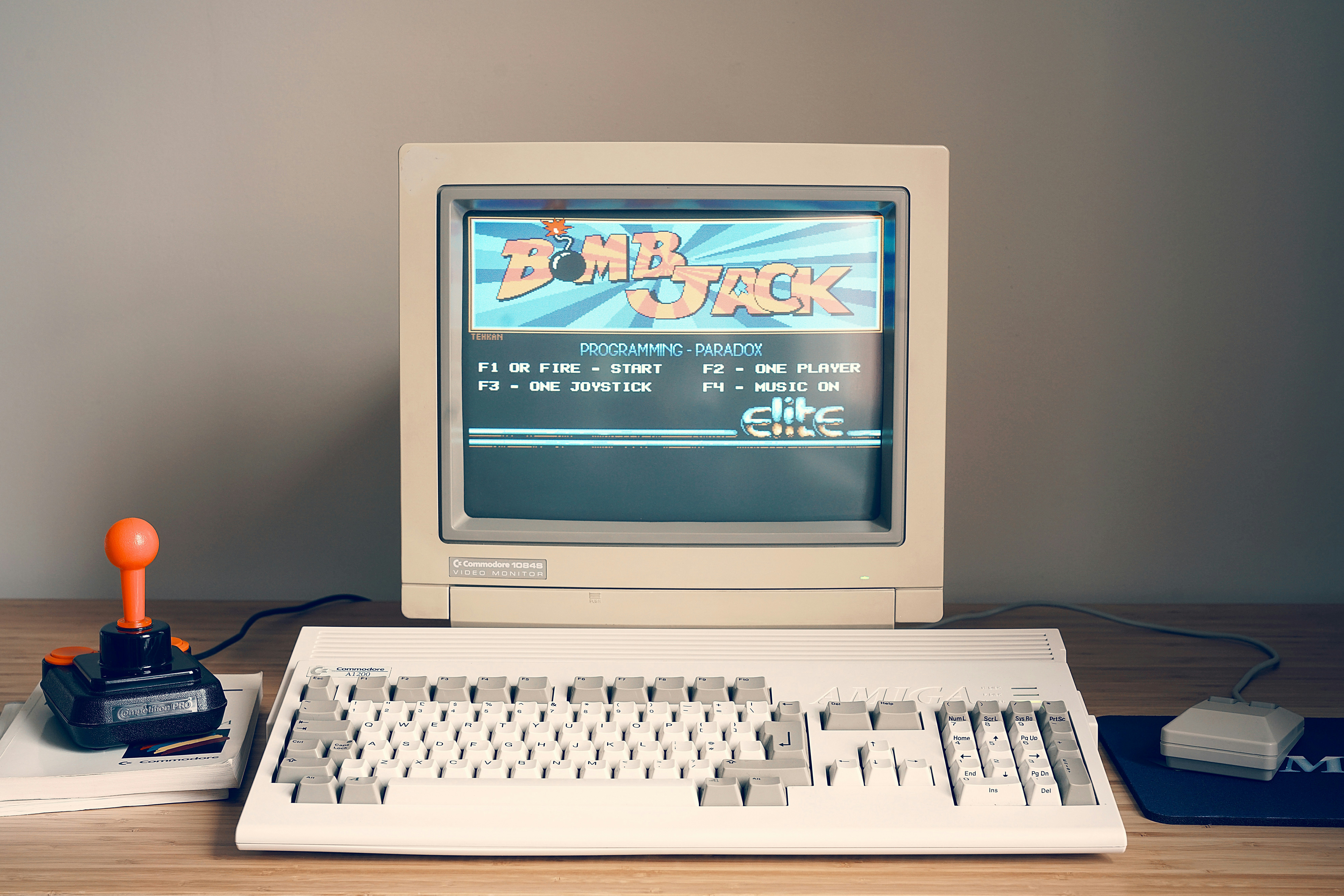
-
What if the Mac never existed?
In that alternate timeline, Steve Jobs and Steve Wozniak never founded Apple. Instead, they stayed at Atari, where both were already known for pushing consumer-friendly design in a company that mostly thought like a coin-op manufacturer.
When Atari’s internal hardware ambitions shifted toward the Lorraine project—the early form of what became the Amiga—it’s almost inevitable that Jobs and Wozniak would have gravitated toward it. The Amiga’s philosophy of custom silicon, multimedia flair, and user-accessible creativity fits their instincts far better than Atari’s more conservative console roadmap.
Then comes the real pivot: the 1984 corporate shuffle. Jack Tramiel buys Atari’s consumer division. The Amiga team jumps to Commodore.
In this world, Jobs and Wozniak follow them because staying at Tramiel-run Atari would be impossible. Jobs and Tramiel would mix like gasoline and a flamethrower. So Jobs lands at Commodore just as the Amiga is preparing to launch.
Under Jobs’s influence, the Amiga is still a multimedia beast, but now wrapped in a much more disciplined product vision. Wozniak’s engineering ethos meshes with the Amiga’s custom chipset philosophy, while Jobs pushes for a unified OS experience, a consistent UI, and an ecosystem strategy. The Amiga launches with real marketing muscle, a far clearer identity, and a push toward creative professionals—video, sound, animation—nearly a decade before the real-world desktop-publishing boom.
But Commodore is still Commodore. By 1985, Jobs is clashing with management over long-term strategy, product focus, and the company’s famously chaotic internal politics. He walks. Wozniak stays a bit longer, contributing to refinements of the Amiga chipset before drifting into education and philanthropic engineering projects.
Jobs founds NeXT exactly as he did in real life. High-end workstation. Black magnesium cube. Laser-focused on higher education and advanced software architectures. But NeXT never finds its footing.
By the mid-90s, Commodore is struggling with the transition to PowerPC hardware and a fragmented OS that has become too archaic for the modern internet.
So in 1995, Commodore does the unthinkable: it buys NeXT.
Suddenly Jobs is back—this time as CEO of Commodore, the company that once couldn’t contain him. NeXTSTEP becomes the backbone of AmigaOS X, a massive leap forward that modernizes the platform overnight.
Developers flock back. Multimedia creators embrace the new tools. The “Think Different” attitude gets welded onto the Amiga brand instead of Apple’s ghost.
By the 2000s, we’re all carrying Commodore AmigaBooks—sleek magnesium laptops running a NeXT-powered AmigaOS X. Creative pros swear by them. Universities standardize on them. The boing-ball logo becomes a status symbol.
And in this alternate history, Commodore doesn’t collapse or fade into the bargain-bin. It becomes the defining force in personal computing—the role Apple would’ve played—while Apple, in this universe, never existed at all.@atomicpoet I don't think it would've been the same. I worked in a lab (science research) in which we had a PC, and few used it. When the boss brought in a Mac, he forced the researchers to use it (only way to make them try it)...and those that had hated the PC found that they loved it. The difference in UI was remarkable. With the Mac, you just had to turn it on and there was no figuring out software or having to type in code and commands, it was just intuitive.
-
@atomicpoet I don't think it would've been the same. I worked in a lab (science research) in which we had a PC, and few used it. When the boss brought in a Mac, he forced the researchers to use it (only way to make them try it)...and those that had hated the PC found that they loved it. The difference in UI was remarkable. With the Mac, you just had to turn it on and there was no figuring out software or having to type in code and commands, it was just intuitive.
@CStamp But what if Steve Jobs managed the Amiga instead of the Mac? -
@CStamp But what if Steve Jobs managed the Amiga instead of the Mac?
@atomicpoet Would he still have attracted people like Larry Tesler and would he have been given enough control to do what he envisioned? He doesn't seem to have been the easiest person to work with and typically, it's the bosses who can get away with that behaviour.
I suspect that things worked out the way they were supposed to work out.
-
@atomicpoet Would he still have attracted people like Larry Tesler and would he have been given enough control to do what he envisioned? He doesn't seem to have been the easiest person to work with and typically, it's the bosses who can get away with that behaviour.
I suspect that things worked out the way they were supposed to work out.
Carolyn Apparently, Steve Jobs and Nolan Bushnell had a great relationship, and Jobs offered him a big share in Atari—which Bushnell declined. And to this day, this is one of Bushnell’s biggest regrets.
So, in my alternative history, rather than leaving Atari, Bushnell recruits both Steves into the development of the Atari 8-bit line. Which, until 1982, was the best-selling home computer line—when it was eclipsed by the Commodore 64.
-
Carolyn Apparently, Steve Jobs and Nolan Bushnell had a great relationship, and Jobs offered him a big share in Atari—which Bushnell declined. And to this day, this is one of Bushnell’s biggest regrets.
So, in my alternative history, rather than leaving Atari, Bushnell recruits both Steves into the development of the Atari 8-bit line. Which, until 1982, was the best-selling home computer line—when it was eclipsed by the Commodore 64.
@atomicpoet I never used one, so don't know what the GUI was like, which was the Mac's strength. If Jobs would've affected that, when it was something that was selling? Who knows?
-
@atomicpoet I never used one, so don't know what the GUI was like, which was the Mac's strength. If Jobs would've affected that, when it was something that was selling? Who knows?
Carolyn This is what Amiga’s OS, known as WorkBench, looked like.
It was functionally very similar to the Mac, and had a GUI.
The main difference between the Mac and Amiga was that the Mac was focused more on desktop publishing, whereas the Amiga was focused on multimedia functionality like animation and sound. Yes, during the 80s.
Famously, Babylon’s special effects were rendered almost entirely on an Amiga because Amiga’s were the only mass market machines capable of this functionality out of the box.
However, Commodore died because, by the 90s, they had the same problems Apple had: no product road map to take them to the next stage.
In other words, there was no Steve Jobs to save them.
-
What if the Mac never existed?
In that alternate timeline, Steve Jobs and Steve Wozniak never founded Apple. Instead, they stayed at Atari, where both were already known for pushing consumer-friendly design in a company that mostly thought like a coin-op manufacturer.
When Atari’s internal hardware ambitions shifted toward the Lorraine project—the early form of what became the Amiga—it’s almost inevitable that Jobs and Wozniak would have gravitated toward it. The Amiga’s philosophy of custom silicon, multimedia flair, and user-accessible creativity fits their instincts far better than Atari’s more conservative console roadmap.
Then comes the real pivot: the 1984 corporate shuffle. Jack Tramiel buys Atari’s consumer division. The Amiga team jumps to Commodore.
In this world, Jobs and Wozniak follow them because staying at Tramiel-run Atari would be impossible. Jobs and Tramiel would mix like gasoline and a flamethrower. So Jobs lands at Commodore just as the Amiga is preparing to launch.
Under Jobs’s influence, the Amiga is still a multimedia beast, but now wrapped in a much more disciplined product vision. Wozniak’s engineering ethos meshes with the Amiga’s custom chipset philosophy, while Jobs pushes for a unified OS experience, a consistent UI, and an ecosystem strategy. The Amiga launches with real marketing muscle, a far clearer identity, and a push toward creative professionals—video, sound, animation—nearly a decade before the real-world desktop-publishing boom.
But Commodore is still Commodore. By 1985, Jobs is clashing with management over long-term strategy, product focus, and the company’s famously chaotic internal politics. He walks. Wozniak stays a bit longer, contributing to refinements of the Amiga chipset before drifting into education and philanthropic engineering projects.
Jobs founds NeXT exactly as he did in real life. High-end workstation. Black magnesium cube. Laser-focused on higher education and advanced software architectures. But NeXT never finds its footing.
By the mid-90s, Commodore is struggling with the transition to PowerPC hardware and a fragmented OS that has become too archaic for the modern internet.
So in 1995, Commodore does the unthinkable: it buys NeXT.
Suddenly Jobs is back—this time as CEO of Commodore, the company that once couldn’t contain him. NeXTSTEP becomes the backbone of AmigaOS X, a massive leap forward that modernizes the platform overnight.
Developers flock back. Multimedia creators embrace the new tools. The “Think Different” attitude gets welded onto the Amiga brand instead of Apple’s ghost.
By the 2000s, we’re all carrying Commodore AmigaBooks—sleek magnesium laptops running a NeXT-powered AmigaOS X. Creative pros swear by them. Universities standardize on them. The boing-ball logo becomes a status symbol.
And in this alternate history, Commodore doesn’t collapse or fade into the bargain-bin. It becomes the defining force in personal computing—the role Apple would’ve played—while Apple, in this universe, never existed at all.@atomicpoet
Does Jobs still get the opportunity to visit Xerox PARC and get inspired by the Alto?Where does Jobs get the cash to start Next?
Does Jobs still reach out to Gates for a cash injection when he returns to Commodore? -
@atomicpoet
Does Jobs still get the opportunity to visit Xerox PARC and get inspired by the Alto?Where does Jobs get the cash to start Next?
Does Jobs still reach out to Gates for a cash injection when he returns to Commodore?Mike Fraser :Jets: :flag: Sure, let’s play with alternative history for a bit because it’s fun.
Yes, Jobs visits the Xerox PARC facility. Steve was also a charismatic guy, so I have no doubt he could find a few VCs to bankroll him. I imagine Jobs would reach out to Gates, and it would succeed for exactly the same reason it succeeded with Apple.