This paper in Management Science has been cited more than 6,000 times. It’s fatally flawed.
-
This post did not contain any content.
-
 S Science shared this topic on
-
This post did not contain any content.
Basically:
" But, yeah, Andy King has a point that when universities, journals, and other institutions support the bad behavior, that’s not good. That doesn’t help at all. In all seriousness, you gotta feel a little sorry for Harvard Business School: they’ve had so many of these scandals now. It’s not like Duke and MIT business schools, which just had one scandal each–actually it was the same scandal for the two of them."
I’ve no knowledge of this publication, this King character and so on. But personally, I don’t have a very high regard of higher learning centres nor especially good experiences. And that was some time ago. It takes a lot to criticise institutions, and it’s worth doing for the better of the world. But you definitely pay a price and therefore my advise -which nobody asked for- would be to honestly ask yourself whether this is the hill you choose to die on. And take it from there.
-
This post did not contain any content.
So is all of Economics and US-style MBA education and “Management science” corporate fluff.
I know it hurts for some people to admit, but Economics is a belief system, a religion without a god but full of cryptids such as “rational economic actors”. It is not a hard science concerned primarily with pursuing the truth but rather a social exercise of maintaining and supporting specific narratives that benefit the ruling class by seeking out evidence for them.
There are people who push back from within Economics and do actual science but they will never be empowered enough to challenge status quo beliefs held by the broader Economics/business community. I consider the few scientists in Economics doing good work to be held hostage within a larger host that is hostile to them.
As far as I am concerned, shut down Harvard Business School, it has hardly done anything but hurt the world by trying to convince us it has answered difficult, meaningful scientific questions with junk work resting on hollow foundations.
This comment on the article from Alex L about sums it up
From my experience in social science, including some experience in managment studies specifically, researchers regularly belief things – and will even give policy advice based on those beliefs – that have not even been seriously tested, or have straight up been refuted. Especially when it fits their prior and/or preferred narratives and/or when it’s just a nice story (I guess ‘companies that do csr stuff outperforming those that don’t’ ticks all those boxes for a lot of people). In that sense, a single study is already a strong basis, comparatively speaking, depressing that may be. Agreed that serious researchers wouldn’t do that, though.
Or this quote from another commenter
incentives don’t work that way in business schools, where career success depends upon creating a clear “brand.” People do not care about science or good research, they care about being known for something specific. So in the case of the junior author on EIS, his career has been built entirely on being “guy who has shown that corporate sustainability is profitable” rather than “guy who does good work on corporate sustainability.”
Plus there are (bad) outside incentives that exist in business schools. As the word “brand” suggests, there are also very lucrative outside options to be gained from telling people something that they want to hear (“sustainability is profitable!”) and very little profit to be made from telling people something inconvenient (“sorry folks, there is no clear relationship between sustainability and profitability, if you want to be more sustainable you’ll have to find some other argument to convince your shareholders”).
-
So is all of Economics and US-style MBA education and “Management science” corporate fluff.
I know it hurts for some people to admit, but Economics is a belief system, a religion without a god but full of cryptids such as “rational economic actors”. It is not a hard science concerned primarily with pursuing the truth but rather a social exercise of maintaining and supporting specific narratives that benefit the ruling class by seeking out evidence for them.
There are people who push back from within Economics and do actual science but they will never be empowered enough to challenge status quo beliefs held by the broader Economics/business community. I consider the few scientists in Economics doing good work to be held hostage within a larger host that is hostile to them.
As far as I am concerned, shut down Harvard Business School, it has hardly done anything but hurt the world by trying to convince us it has answered difficult, meaningful scientific questions with junk work resting on hollow foundations.
This comment on the article from Alex L about sums it up
From my experience in social science, including some experience in managment studies specifically, researchers regularly belief things – and will even give policy advice based on those beliefs – that have not even been seriously tested, or have straight up been refuted. Especially when it fits their prior and/or preferred narratives and/or when it’s just a nice story (I guess ‘companies that do csr stuff outperforming those that don’t’ ticks all those boxes for a lot of people). In that sense, a single study is already a strong basis, comparatively speaking, depressing that may be. Agreed that serious researchers wouldn’t do that, though.
Or this quote from another commenter
incentives don’t work that way in business schools, where career success depends upon creating a clear “brand.” People do not care about science or good research, they care about being known for something specific. So in the case of the junior author on EIS, his career has been built entirely on being “guy who has shown that corporate sustainability is profitable” rather than “guy who does good work on corporate sustainability.”
Plus there are (bad) outside incentives that exist in business schools. As the word “brand” suggests, there are also very lucrative outside options to be gained from telling people something that they want to hear (“sustainability is profitable!”) and very little profit to be made from telling people something inconvenient (“sorry folks, there is no clear relationship between sustainability and profitability, if you want to be more sustainable you’ll have to find some other argument to convince your shareholders”).
Economics isn’t just a belief system, but it’s also not a hard science. It’s basically an offshoot of sociology.
-
Economics isn’t just a belief system, but it’s also not a hard science. It’s basically an offshoot of sociology.
Economics in general can be defined as a set of narratives hunting for evidence, which makes it fundamentally NOT a science “hard or soft” since the pursuit of truth is compromised at the very beginning of conducting any would-be science.
If you go hunting for evidence by forcing abstract definitions and pre-constructed mental structures onto reality and repeating the process until you get promising results, even if you somehow come out with the right answer you aren’t doing science.
A genuine science would welcome these alternative perspectives and subject them to rigorous testing against orthodox theories. The fact that economics maintains competing schools that fundamentally disagree on basic questions—and resolves this through institutional power rather than evidence—reveals that it functions more like competing ideologies than scientific theories.
…
The 2008 financial crisis illustrates this problem perfectly. The crisis did not occur because people suddenly became irrational or because of external shocks. It emerged from systematic interactions of rational actors operating within particular rules and institutions—exactly the kind of systemic phenomenon that mainstream economics struggles to understand because of its reductionist focus on individuals.
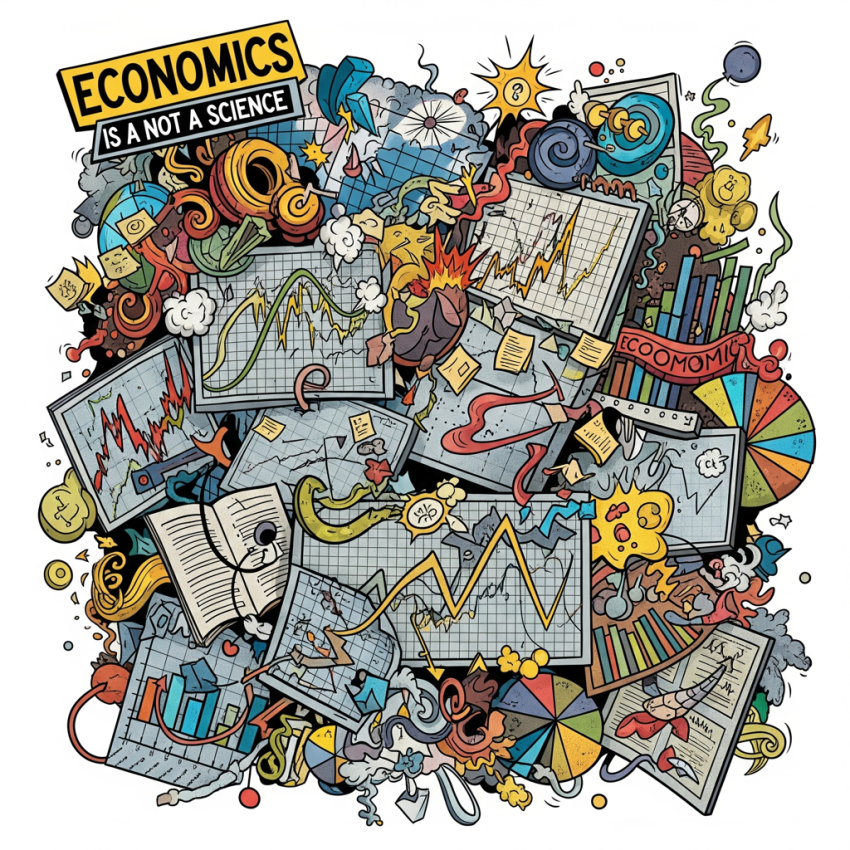
Economics is not a Science - Chevan Nanayakkara
Economics claims to be a scientific discipline that discovers universal laws governing human behavior and market dynamics. This claim is demonstrably false.

Chevan Nanayakkara - Systems Thinking About Thinking Systems (chevan.info)
-
Economics isn’t just a belief system, but it’s also not a hard science. It’s basically an offshoot of sociology.
Have you read any of Nassim Nicolas Taleb’s work? His writing is what comes to mind when people defend economics.
-
Economics in general can be defined as a set of narratives hunting for evidence, which makes it fundamentally NOT a science “hard or soft” since the pursuit of truth is compromised at the very beginning of conducting any would-be science.
If you go hunting for evidence by forcing abstract definitions and pre-constructed mental structures onto reality and repeating the process until you get promising results, even if you somehow come out with the right answer you aren’t doing science.
A genuine science would welcome these alternative perspectives and subject them to rigorous testing against orthodox theories. The fact that economics maintains competing schools that fundamentally disagree on basic questions—and resolves this through institutional power rather than evidence—reveals that it functions more like competing ideologies than scientific theories.
…
The 2008 financial crisis illustrates this problem perfectly. The crisis did not occur because people suddenly became irrational or because of external shocks. It emerged from systematic interactions of rational actors operating within particular rules and institutions—exactly the kind of systemic phenomenon that mainstream economics struggles to understand because of its reductionist focus on individuals.
Economics is not a Science - Chevan Nanayakkara
Economics claims to be a scientific discipline that discovers universal laws governing human behavior and market dynamics. This claim is demonstrably false.
Chevan Nanayakkara - Systems Thinking About Thinking Systems (chevan.info)
The waters are getting muddy once we start discussing hard & soft sciences, beliefsystems and politics.
But economics only works because of its underlying premises . These premises can be eroded, like: trust, open and transparent market, and trade, iirc.
-
The waters are getting muddy once we start discussing hard & soft sciences, beliefsystems and politics.
But economics only works because of its underlying premises . These premises can be eroded, like: trust, open and transparent market, and trade, iirc.
And the changes to the underlying premises as well as their impacts are part of the study of economics.
-
Economics in general can be defined as a set of narratives hunting for evidence, which makes it fundamentally NOT a science “hard or soft” since the pursuit of truth is compromised at the very beginning of conducting any would-be science.
If you go hunting for evidence by forcing abstract definitions and pre-constructed mental structures onto reality and repeating the process until you get promising results, even if you somehow come out with the right answer you aren’t doing science.
A genuine science would welcome these alternative perspectives and subject them to rigorous testing against orthodox theories. The fact that economics maintains competing schools that fundamentally disagree on basic questions—and resolves this through institutional power rather than evidence—reveals that it functions more like competing ideologies than scientific theories.
…
The 2008 financial crisis illustrates this problem perfectly. The crisis did not occur because people suddenly became irrational or because of external shocks. It emerged from systematic interactions of rational actors operating within particular rules and institutions—exactly the kind of systemic phenomenon that mainstream economics struggles to understand because of its reductionist focus on individuals.
Economics is not a Science - Chevan Nanayakkara
Economics claims to be a scientific discipline that discovers universal laws governing human behavior and market dynamics. This claim is demonstrably false.
Chevan Nanayakkara - Systems Thinking About Thinking Systems (chevan.info)
Economics is just a branch of science concerned with the production, consumption, and transfer of wealth. It’s not a problem looking for a solution, it’s an attempt at understanding an extremely complex system.
It sounds like you have a problem with economic theories/systems and people being unwilling to acknowledge the flaws in them, which is a valid problem to have.
But name a branch of science that hasn’t pushed bad theories and resisted evidence to the contrary.
-
This post did not contain any content.
So, cut short, management “science” is anything but science. Having read the books needed to get an Harvard MBA and having some good laughs about them, I am not surprised. This is just one big scam. They don’t go to Harvard for knowledge, they go there solely for “elite connections”. And it shows, wherever those managers go.
-
This post did not contain any content.
I’m in an MBA program and it is even dumber than I had assumed.