You are not (just) your brain

-
This post did not contain any content.
-
 S Science shared this topic
-
This post did not contain any content.
Tell that to this guy

-
This post did not contain any content.
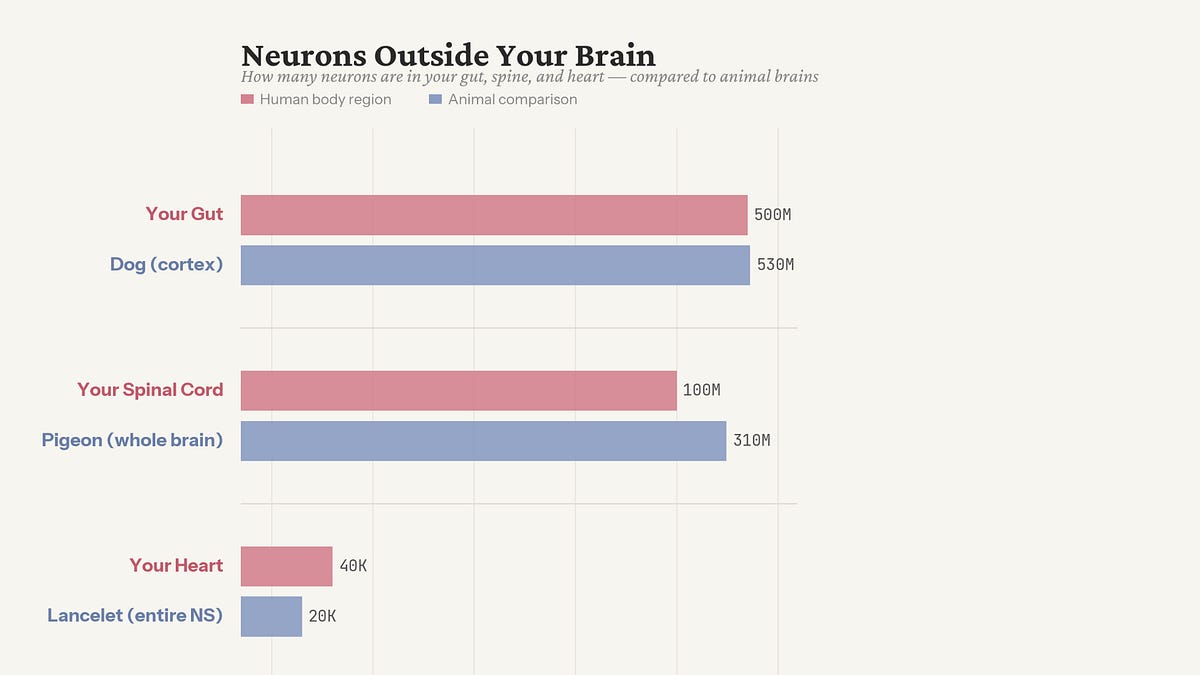
Each eye has around one and a half to twice as many neurons (high estimates put the number between 120 and 150k, low estimates at 75-110k), roughly, as the heart. Ergo, I exist in my Stomach, Two Eyes, and my Brain more than anywhere else in the body? Also, depending on some estimates, the lumbosacral plexus has more neurons than the heart (150,000 for motor control of each leg, give or take depending on well-known estimates)… So my thighs aren’t just thick, they’re also a seat of neurological control.
We also have like 8 Ganglion clusters (sub brains, if you will) that allow for autonomic control of organs when BigBrain
 isn’t functioning correctly.
Also, at best there is a strong (but increasingly weak in larger studies) correlation between Neuron count and neurofunctional complexity. It helps to read more literature than the one paper that is found to support a chosen argument…
https://d-nb.info/1332809901/34
https://karger.com/bbe/article/99/2/109/860281/The-Relationship-between-Cognition-and-Brain-SizeTo the point of this: It is not “neuro-reductionist” to focus on the brain as the seat of Neurology in the human body. Take away the brain entirely and we know that these substructures stop computing. No one involved in the study of neurology thinks we are entirely in our own brains, but they do think the brain is the core element of human neurology.
-
Tell that to this guy
It kinda explains his behavioral issues, if anything.
-
This post did not contain any content.
I remember an old documentary in which a person, after an heart transplant, had little changes in personality.
If my memory don’t fool me, the donor was a surfer and the recipient started like greeting or something like him.
-
It kinda explains his behavioral issues, if anything.
He just need his needs met so he can strive for self-actualization. 🥺
-
Each eye has around one and a half to twice as many neurons (high estimates put the number between 120 and 150k, low estimates at 75-110k), roughly, as the heart. Ergo, I exist in my Stomach, Two Eyes, and my Brain more than anywhere else in the body? Also, depending on some estimates, the lumbosacral plexus has more neurons than the heart (150,000 for motor control of each leg, give or take depending on well-known estimates)… So my thighs aren’t just thick, they’re also a seat of neurological control.
We also have like 8 Ganglion clusters (sub brains, if you will) that allow for autonomic control of organs when BigBrain
isn’t functioning correctly.Also, at best there is a strong (but increasingly weak in larger studies) correlation between Neuron count and neurofunctional complexity. It helps to read more literature than the one paper that is found to support a chosen argument…
https://d-nb.info/1332809901/34
https://karger.com/bbe/article/99/2/109/860281/The-Relationship-between-Cognition-and-Brain-SizeTo the point of this: It is not “neuro-reductionist” to focus on the brain as the seat of Neurology in the human body. Take away the brain entirely and we know that these substructures stop computing. No one involved in the study of neurology thinks we are entirely in our own brains, but they do think the brain is the core element of human neurology.
At least as relevant is the question of what the exact seat of consciousness/identity actually is. We don’t expect a mass of neurons to become conscious simply by adding more neurons.
-
I remember an old documentary in which a person, after an heart transplant, had little changes in personality.
If my memory don’t fool me, the donor was a surfer and the recipient started like greeting or something like him.
There is some limited evidence to suggest that heart transplants can transfer aspects of the donors’ personality and possibly even traumatic memories over to the recipient (see here ). There are also a lot of anecdotes that effect (eg this or the one you mentioned). I actually even remember once hearing a story of a woman who claimed she became lesbian after a heart transplant.
-
This post did not contain any content.
If a heart transplant is reported to give the recipient some memory and characteristics from the donor it makes you wonder how much of your personality and behavior is derived from your gut with ten times the neurons that a heart has.
How many behavioral and psychological issues may be related to the gut? It is a fascinating question.
-
This post did not contain any content.
Hm, just to add: it take about memories from heart transplants, citing a paper that describes in a minority of cases in both heart and other organ transplants show changed in memories, making the “heart neurons do stuff” a bit less strong.
Also at some point it cites some kind of LinkedIn text that reeks of AI (double sections and unnecessary repetition), so imma call skepticism on this one.
Still agree that the gut and other things have an interesting amount of information to process (or be involved in metabolic/nutrition processes that are super important for good brain functioning, like the whole “a lot of serotonin is made in the gut” thing? But not convinced its comparable to the pretty elaborate neocortical Networks and conscious experience.