Skip to content
  • 10 Votes
    1 Posts
    19 Views
    S
    cross-posted from: https://mander.xyz/post/41671286 Archived version The European Commission is preparing to block Chinese institutions from significant portions of its €95.5 billion ($110 billion) Horizon Europe research program, citing intellectual property risks and links between Chinese universities and Beijing’s military. A draft document for the Horizon Europe “main” work program for 2026/2027 proposes excluding Chinese entities from three of the six research areas: civil security and society; health; and digital, industry and space technologies. The proposals have not yet been adopted or endorsed by the European Commission, although they are clearly being considered. The restrictions respond to lack of progress on an EU-China cooperation roadmap established at the 2019 Innovation Cooperation Dialogue. The Commission points to persistent concerns about protecting trade secrets and potential transfer of knowledge to China’s military, which it says are “supported rather than deterred” by Beijing’s policies. “In view of the persistent lack of progress in the discussions on the Roadmap and the substantive concerns in relation to the undesired transfer of IP to China supported by both legislative and policy initiatives, cooperation involving entities established in China needs to be calibrated accordingly,” it states. …
  • 3 Votes
    1 Posts
    44 Views
    S
    … China’s leadership is moving further away from its promises, despite Xi [Jinping]’s claims of ostensible progress, asserting that Chinese women are now “participating in the entire process of national and social governance with unprecedented confidence and vigor,” and positioning them as “protagonists.” The clearest testament to this regression lies in Xi’s addresses to the All-China Women’s Federation (ACWF) – the official state women’s organization under the Communist Party – in 2013, 2018, and 2023. Across these speeches, Xi consistently advanced patriarchal narratives that cast women primarily as caretakers and moral anchors within the family. Yet his 2023 address marked a further step, urging the cultivation of “a new type of marriage and parenting culture” and the promotion of childbirth, effectively marginalizing women’s professional work and silencing their agency beyond domestic and reproductive roles. … Women in STEM are celebrated as symbols of national progress [in China], yet this recognition often amounts to ideological instrumentalization. They are valued primarily as a labor force to drive national development goals and to project an image of modernity, progress, and national strength, rather than as fully empowered agents in their own right. Simultaneously, this exists in stark tension with the state’s enduring patriarchal and pro-natalist policies, driven by demographic concerns, which continue to frame women primarily as reproducers and custodians of family life. This paradox is also exposed by the data which reveals that beneath the state’s celebration of women’s purported achievements in science and technology lies a persistent pattern of underrepresentation, pay disparities, and barriers that limit advancement. Official figures show that nearly 40 million women are employed in science and technology, making up 45.8 percent of China’s STEM workforce. Yet fewer than three million work in research and development. … In 2022–23, women accounted for 63 percent of all new university entrants, but in elite institutions and STEM-focused majors, male dominance quickly reasserts itself. At the prestigious C9 universities (China’s top tier), female undergraduates make up only 37.7 percent, well below the national average. Disciplinary divides are even starker: physics departments in some universities record male-to-female ratios of 19:1, while women comprise only 25–30 percent of students in computer science and electronic engineering. … Women also face systemic disadvantages in funding and visibility. They are underrepresented on peer review panels and high-level selection committees, reducing their chances of securing grants. Although women make up roughly half of university instructors, they occupy only one-third of master’s advisor roles and fewer than 17 percent of doctoral advisor positions. Pay disparities are substantial: across sectors and education levels, women earn on average only 71.6 percent of what men do. In high-prestige publishing, the imbalance is also stark: in 2023, only five of 101 corresponding authors with Chinese affiliations in “Nature” were women, highlighting their scarcity in global scientific leadership. … Yet the challenges women face in STEM are not isolated – they reflect a longer history of gendered constraints and feminist activism in China. As early as the late nineteenth and early twentieth centuries, Western feminism, rooted in liberal ideals of individual rights and autonomy, sought to affirm women as rational citizens entitled to legal and political recognition. Chinese feminism, by contrast, emerged in the context of national modernization and liberation from feudalism and imperialism. Following 1949, Mao Zedong’s famous dictum that “women hold up half the sky” reframed empowerment as a collective contribution to socialist nation-building rather than a pursuit of individual rights. …
  • 9 Votes
    2 Posts
    68 Views
    A
    Consistent with these findings, our study confirmed rapid S1 protein entry into multiple brain regions and demonstrated that S1 exposure leads to impairments in episodic memory, spatial learning, and increased anxiety, suggesting that persistent spike protein contributes to long-term cognitive decline. Earlier in the article they state that around 28% of surviving patients experience “brain fog” for months or years. That is people that have it bad enough to search for medical care. This many people having lower memory and learning abilities and living with heightened anxiety would explain a lot of things.
  • 4 Votes
    2 Posts
    61 Views
    P
    30 September 2025 Editor’s note: Readers are alerted that the authors have identified errors in the data presented in this article. Further editorial action will be taken if appropriate once the original data have been validated and the impact of the required changes to the article has been reviewed by the Editors.
  • 16 Votes
    7 Posts
    224 Views
    Y
    Maybe it’s a related reference to another property. Sorry dude, didn’t mean to upset you.
  • 6 Votes
    1 Posts
    56 Views
    C
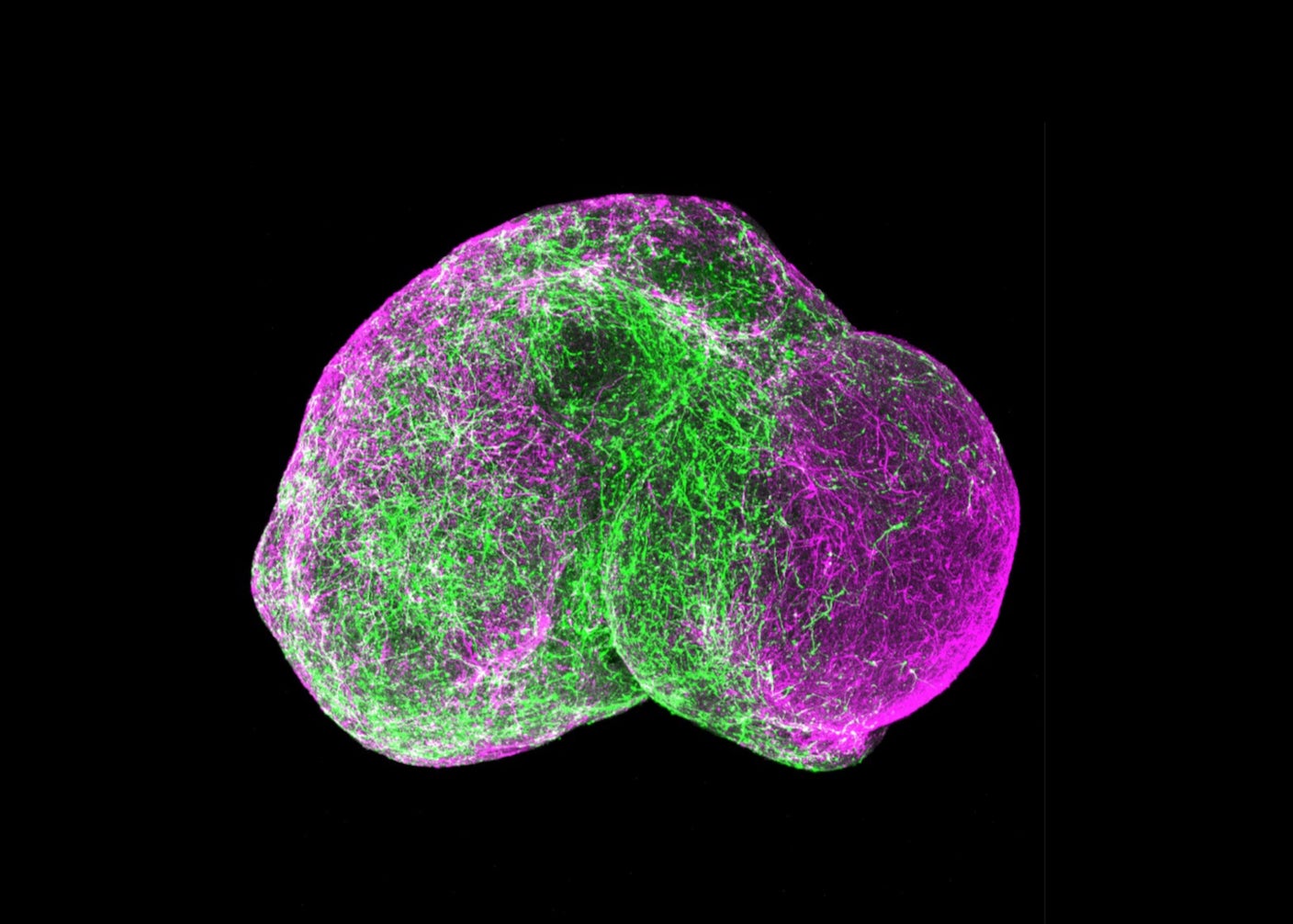
    Researchers used an AI based on GPT architecture to map the brain, and they found it’s way more complex than we thought. Instead of the ~52 broad regions we’ve been working with, the AI identified about 1,300 distinct areas. They trained a model called Cell Transformer on mouse brain scans. Instead of learning language, it learned the “grammar” of how brain cells are organized relative to their neighbors. It then automatically drew the borders between brain regions with high precision, revealing hidden neighborhoods we never knew existed. With a map this detailed, researchers can now pinpoint the tiny, specific cellular areas involved in conditions like Alzheimer’s and depression. Having such a detailed map could massively speed up research and lead to much more targeted and effective treatments in the future.
  • 10 Votes
    1 Posts
    59 Views
    O
    This post did not contain any content.
  • 6 Votes
    3 Posts
    105 Views
    2
    TIL my boss thinks I’m an LLM
  • 52 Votes
    3 Posts
    92 Views
    B
    While I will, of course, hold back some enthusiasm until I see these results replicated, this appears to be one of the rare real scientific breakthroughs we love to hear about. Great news for all the sufferers of CFS, and big props to all the scientists who worked on this discovery!
  • 14 Votes
    6 Posts
    176 Views
    titanicx@lemmy.zipT
    Looks more like a prawn to me
  • 21 Votes
    3 Posts
    95 Views
    B
    [image: 1297f2f7-8bb8-4d7e-987a-76971ceb454a.png]
  • 50 Votes
    3 Posts
    98 Views
    D
    Terrible to see, great this was discovered.
  • 1 Votes
    5 Posts
    153 Views
    Q
    I can go one step further. They provided their own handy summary. Here’s what you’ll learn when you read this story: The longest-lived mammals on Earth, bowhead whales, contain longevity secrets that scientists hope could be applied to our own biology. A new study analyzes gene repairing proteins and found that bowhead whales contain 100 times the concentration of CIRBP, a protein that repairs genetic damage known as double-strand breaks. They also found that the specimens subjected to colder temperatures tended to produce more of these proteins, a nifty trick for a species that lives in arctic waters.
  • 0 Votes
    2 Posts
    77 Views
    Jürgen HubertJ
    @jeffowski I translate 19th century German folklore, and I can confirm.The most gruesome tale I have come across was about a "miracle doctor" who promised to revive a dead infant for just long enough so that it could receive the emergency baptism that had been denied to it.
  • #meme #media #science

    Uncategorized meme media science
    1
    1
    0 Votes
    1 Posts
    49 Views
    Chao-c'X
    #meme #media #science
  • 11 Votes
    2 Posts
    37 Views
    S
    Wonder if it’s also seen in ME/CFS sufferers.
  • 27 Votes
    1 Posts
    53 Views
    S
    Electrons inside solid materials behave in a surprisingly similar way. When they gain extra energy (for instance, when the material is struck by other electrons), they can sometimes break free from the solid. This process has been known for decades and forms the basis of many technologies. However, until recently, scientists had been unable to calculate it with precision. Researchers from several groups at TU Wien have now found the solution. Just as the frog must find the right opening, an electron also needs to locate a specific “exit,” known as a “doorway state.” … The key discovery is that energy alone cannot determine whether an electron escapes. There are quantum states above the energy threshold that still fail to lead out of the material, a fact missing from earlier models. “From an energetic point of view, the electron is no longer bound to the solid. It has the energy of a free electron, yet it still remains spatially located where the solid is,” says Richard Wilhelm. The electron behaves like the frog that jumps high enough but fails to find the exit. “The electrons must occupy very specific states – so-called doorway states,” explains Prof. Florian Libisch from the Institute for Theoretical Physics. “These states couple strongly to those that actually lead out of the solid. Not every state with sufficient energy is such a doorway state – only those that represent an ‘open door’ to the outside.”
  • Science Must Decentralize

    Uncategorized science
    2
    34 Votes
    2 Posts
    61 Views
    R
    When the current GOP admin started dismantling science in the USA, it occurred to me that a positive outcome might be the decentralization of science.
  • 13 Votes
    4 Posts
    134 Views
    P
    Awwww! ~fire-up the grill~
  • 56 Votes
    15 Posts
    509 Views
    P
    Neither the ancient Greeks nor the ancient Chinese had video recording or even photography, which seems to be the metaphor that allows people to explain what they do or don’t have. I must have relatively weak mental imagery? I can imagine seeing an apple, or recall the visual memory of my fruit bowl, but I’m hard-pressed to extract any definitive visual information from it, like I could if I really was looking at it. I’m visualizing the fruit bowl, but how many apples am I visualizing exactly? If I decide I’m visualizing two, now I’ve lost the relationship between the banana and the orange. I can see the Mona Lisa, but where do her arms go, actually? Maybe sort of crossed somewhere? What’s going on behind her, some kind of green-brown pointy trees? Nope, there’s her cheek again and some paint cracks. It’s less like looking at a picture and more like dreaming of one.