I come from a family of teachers - both parents taught all their lives and now oversee Ed
-
I come from a family of teachers - both parents taught all their lives and now oversee Ed.D candidates, brother owns a school - which has left me painfully aware of the fact that I am *not* a great teacher.
--
If you'd like an essay-formatted version of this thread to read or share, here's a link to it on pluralistic.net, my surveillance-free, ad-free, tracker-free blog:
1/

-
I come from a family of teachers - both parents taught all their lives and now oversee Ed.D candidates, brother owns a school - which has left me painfully aware of the fact that I am *not* a great teacher.
--
If you'd like an essay-formatted version of this thread to read or share, here's a link to it on pluralistic.net, my surveillance-free, ad-free, tracker-free blog:
1/
I am, however, a *good* teacher. The difference is that a good teacher can teach students who want to learn, whereas a great teacher can inspire students to *want to learn*. I've spent most of my life teaching, here and there, and while I'm not great, I am getting better.
2/
-
I am, however, a *good* teacher. The difference is that a good teacher can teach students who want to learn, whereas a great teacher can inspire students to *want to learn*. I've spent most of my life teaching, here and there, and while I'm not great, I am getting better.
2/
Last year, I started a new teaching gig: I'm one of Cornell's AD White Visiting Professors, meaning that I visit Cornell (and its NYC campus, Cornell Tech) every year or two for six years and teach, lecture, meet, and run activities.
3/
-
Last year, I started a new teaching gig: I'm one of Cornell's AD White Visiting Professors, meaning that I visit Cornell (and its NYC campus, Cornell Tech) every year or two for six years and teach, lecture, meet, and run activities.
3/
When I was in Ithaca in September for my inaugural stint, I had a string of what can only be called "peak experiences," meeting with researchers, teachers, undergrads, grads and community members. I had so many conversations that will stick with me, and today I want to talk about one of them.
4/
-
When I was in Ithaca in September for my inaugural stint, I had a string of what can only be called "peak experiences," meeting with researchers, teachers, undergrads, grads and community members. I had so many conversations that will stick with me, and today I want to talk about one of them.
4/
It was a faculty talk. One person at the table had been involved in a research project to investigate students' attitudes to their education. The research concluded that students come to Cornell to learn - because they love knowledge and critical thinking - but they so haunted by the financial consequences of failure (wasting tens, if not hundreds, of thousands of dollars repeating a year or failing out altogether, and then entering the job market debt-burdened and degree-less).
5/
-
It was a faculty talk. One person at the table had been involved in a research project to investigate students' attitudes to their education. The research concluded that students come to Cornell to learn - because they love knowledge and critical thinking - but they so haunted by the financial consequences of failure (wasting tens, if not hundreds, of thousands of dollars repeating a year or failing out altogether, and then entering the job market debt-burdened and degree-less).
5/
As a result, they feel pressured not to take intellectual risks, and, at worst, to cheat. They *care* about learning, but they're *afraid* of bad grades, and so chasing grades triumphs over learning.
At that same discussion, I met someone who taught Cornell's version of freshman comp, the "here's how to write at a college level" course that every university offers. I've actually guest-taught some of these, starting in 2005/6, when I had a Fulbright Chair at USC.
6/
-
As a result, they feel pressured not to take intellectual risks, and, at worst, to cheat. They *care* about learning, but they're *afraid* of bad grades, and so chasing grades triumphs over learning.
At that same discussion, I met someone who taught Cornell's version of freshman comp, the "here's how to write at a college level" course that every university offers. I've actually guest-taught some of these, starting in 2005/6, when I had a Fulbright Chair at USC.
6/
Now, while I'm not a great teacher, I am a pretty good *writing* teacher. I was lucky enough to be mentored by Judith Merril (starting at the age of 9!), who taught me how to participate in a peer-based writing workshop:
7/
-
Now, while I'm not a great teacher, I am a pretty good *writing* teacher. I was lucky enough to be mentored by Judith Merril (starting at the age of 9!), who taught me how to participate in a peer-based writing workshop:
7/
In high school, I met Harriet Wolff, a gifted writing teacher, whose writing workshop (which Judith Merril had actually founded, decades earlier) was so good that I spent seven years in my four-year high-school, mostly just to keep going to Harriet's workshop:
8/
-
In high school, I met Harriet Wolff, a gifted writing teacher, whose writing workshop (which Judith Merril had actually founded, decades earlier) was so good that I spent seven years in my four-year high-school, mostly just to keep going to Harriet's workshop:
8/
I graduated from the Clarion science fiction and fantasy workshop (where Judith Merril learned to workshop) in 1992, and then went on to teach Clarion and Clarion West on several occasions, as well as other workshops in the field, such as Viable Paradise (today, I volunteer for Clarion's board). I have taught and been taught, and I've learned a thing or two.
9/
-
I graduated from the Clarion science fiction and fantasy workshop (where Judith Merril learned to workshop) in 1992, and then went on to teach Clarion and Clarion West on several occasions, as well as other workshops in the field, such as Viable Paradise (today, I volunteer for Clarion's board). I have taught and been taught, and I've learned a thing or two.
9/
Here's the thing about every successful writing workshop I've been in: they don't necessarily make writing enjoyable (indeed, they can be painful), but they make it profoundly *satisfying*. When you repeatedly sit down with the same writers, week after week, to think about what went wrong with their work, and how they can fix it, and to hear the same about your work, something changes in how you relate to your work.
10/
-
Here's the thing about every successful writing workshop I've been in: they don't necessarily make writing enjoyable (indeed, they can be painful), but they make it profoundly *satisfying*. When you repeatedly sit down with the same writers, week after week, to think about what went wrong with their work, and how they can fix it, and to hear the same about your work, something changes in how you relate to your work.
10/
You come to understand how to transform big, inchoate ideas into structured narratives and arguments, sure - but you also learn to recognize when the structure that emerges teaches you something about those big, inchoate ideas that was there all along, but not visible to you.
It's revelatory. It teaches you what you know. It lets you know what you know. It lets you know *more* than you know.
11/
-
You come to understand how to transform big, inchoate ideas into structured narratives and arguments, sure - but you also learn to recognize when the structure that emerges teaches you something about those big, inchoate ideas that was there all along, but not visible to you.
It's revelatory. It teaches you what you know. It lets you know what you know. It lets you know *more* than you know.
11/
It's alchemical. It creates new knowledge, and dispels superstition. It sharpens how you think. It sharpens how you talk. And obviously, it sharpens how you write.
The freshmen comp students I've taught over the years were amazed (or, more honestly, incredulous) when I told them this, because for them, writing was a totally pointless exercise. Well, *almost* totally pointless. Writing had one point: to get a passing grade so that the student could advance to other subjects.
12/
-
It's alchemical. It creates new knowledge, and dispels superstition. It sharpens how you think. It sharpens how you talk. And obviously, it sharpens how you write.
The freshmen comp students I've taught over the years were amazed (or, more honestly, incredulous) when I told them this, because for them, writing was a totally pointless exercise. Well, *almost* totally pointless. Writing had one point: to get a passing grade so that the student could advance to other subjects.
12/
I'm not surprised by this, nor do I think it's merely because some of us are born to write and others will never get the knack (I've taught too many writers to think that anyone can guess who will find meaning in writing). It's because we don't generally teach writing this way until the most senior levels - the last year or two of undergrad, or, more likely, grad school (and then only if that grad program is an MFA).
13/
-
I'm not surprised by this, nor do I think it's merely because some of us are born to write and others will never get the knack (I've taught too many writers to think that anyone can guess who will find meaning in writing). It's because we don't generally teach writing this way until the most senior levels - the last year or two of undergrad, or, more likely, grad school (and then only if that grad program is an MFA).
13/
Writing instruction at lower levels, particularly in US high schools, is organized around standardized assessment. Students are trained to turn out the world's worst literary form: the five-paragraph essay:
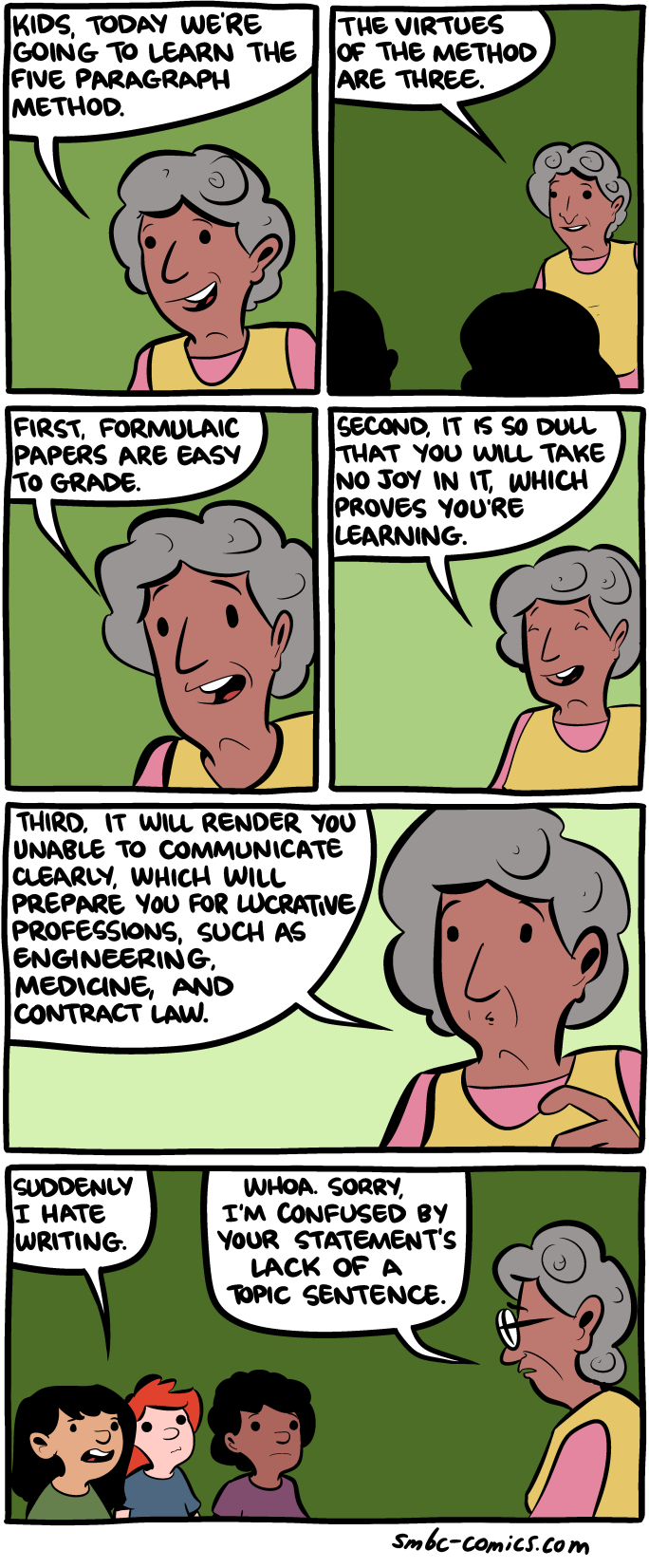
Saturday Morning Breakfast Cereal - Apple
Saturday Morning Breakfast Cereal - Apple
(www.smbc-comics.com)
The five-paragraph essay is so rigid that *any* attempt to enliven it is actually *punished* during the grading process. One cannot deviate from the structure, on penalty of academic censure.
14/
-
Writing instruction at lower levels, particularly in US high schools, is organized around standardized assessment. Students are trained to turn out the world's worst literary form: the five-paragraph essay:
Saturday Morning Breakfast Cereal - Apple
Saturday Morning Breakfast Cereal - Apple
(www.smbc-comics.com)
The five-paragraph essay is so rigid that *any* attempt to enliven it is actually *punished* during the grading process. One cannot deviate from the structure, on penalty of academic censure.
14/
It's got all the structural constraints of a sonnet, and all the poetry of a car crusher.
The five-paragraph essay is so terrible that a large part of the job of a freshman comp teacher is to teach students to *stop* writing them. But even after this is done, much of the freshman comp curriculum is also formulaic (albeit with additional flexibility). That's unavoidable: freshman comp classes are typically *massive*, since so many of the incoming students have to take it.
15/
-
It's got all the structural constraints of a sonnet, and all the poetry of a car crusher.
The five-paragraph essay is so terrible that a large part of the job of a freshman comp teacher is to teach students to *stop* writing them. But even after this is done, much of the freshman comp curriculum is also formulaic (albeit with additional flexibility). That's unavoidable: freshman comp classes are typically *massive*, since so many of the incoming students have to take it.
15/
When you're assessing 100-2,000 students, you necessarily fall back on formula.
Which brings me back to that faculty discussion at Cornell, where we learned first that students want to learn, but are afraid of failure; and then heard from the freshman comp teacher, who told us that virtually all of their students cheated on their assignments, getting chatbots to shit out their papers.
16/
-
When you're assessing 100-2,000 students, you necessarily fall back on formula.
Which brings me back to that faculty discussion at Cornell, where we learned first that students want to learn, but are afraid of failure; and then heard from the freshman comp teacher, who told us that virtually all of their students cheated on their assignments, getting chatbots to shit out their papers.
16/
And that's what I've been thinking about since September. Because of *course* those students cheat on their writing assignments - they are being taught to hit mechanical marks with their writing, improving their sentence structure, spelling and punctuation. What they're *not* learning is how to use writing to order and hone their thoughts, or to improve their ability to express those thoughts. They're being asked to write *like* a chatbot - why *wouldn't* they use a chatbot?
17/
-
And that's what I've been thinking about since September. Because of *course* those students cheat on their writing assignments - they are being taught to hit mechanical marks with their writing, improving their sentence structure, spelling and punctuation. What they're *not* learning is how to use writing to order and hone their thoughts, or to improve their ability to express those thoughts. They're being asked to write *like* a chatbot - why *wouldn't* they use a chatbot?
17/
@pluralistic
One thing that really stuck out to me when I was in school: a lot of people seem to not get the *point* of sentence structure, spelling, or punctuation. They think that such things exist purely as hoops to jump through to stave off the wrath of a teacher, rather than as legibility aids. When they don't perfectly map to the spoken word, they're seen as even more arbitrary.Writing good dialogue involves learning how to make legible text that still sounds like real speech.