The Pros and Cons of Fantasy Counterpart Cultures

-
The practice of using fantasy counterpart cultures - cultures and societies that are very similar to real world cultures of specific times and places - has a long history in fantasy in general, and fantasy RPGs in particular.
And, in truth, there are good reasons for that. Fantasy worldbuilding is a major task, and fantasy worldbuilding for RPGs in particular requires that not only the GM understands any given culture, but the players as well - but understanding a culture requires a lot of effort, and there is only so much time everyone at the table has available for that.
Thus, using familiar elements is a great time saver. The main reason we see the same Tolkien ancestries over and over again (elves, dwarves, halflings, orcs…) is that most players of fantasy RPGs are already familiar with their basic concepts, and thus only have to learn what is different from the norm. But you create fantasy ancestries from scratch, you need to convey all that information to the players.
The same applies to fantasy counterpart cultures - if you have a vague familiarity with the real world culture, then familiarizing yourself with a fantasy culture will be a lot easier.
However, there’s also a lot that can go wrong with using fantasy counterpart cultures. Misrepresentation is always a danger, especially with marginalized groups and if the developers did not consult with members of that culture. Likewise, if you are building a fantasy counterpart culture of a nation that has some ugly history, then you risk whitewashing that history.
So what are your thoughts? Do you like to have fantasy counterpart cultures in your settings, or do you prefer to avoid them? And what are some good examples of fantasy counterpart cultures done right?
never saw it as severly as in the belgariad.
-
I’m a forever GM. I’d like to create totally unique and interesting cultures, but I only have so many hours. Like, I have a max of four hours of prep time a week, and I need to make battlemaps, tokens, NPCs, chart out the main plot, and build beats for the next session.
Sometimes I think I’m creating something new. But it’s usually some trope I forgot about.
Originality is a myth. Everyone is just putting their own personal spin on something that others have already done. Embrace this, or go mad.

-
The practice of using fantasy counterpart cultures - cultures and societies that are very similar to real world cultures of specific times and places - has a long history in fantasy in general, and fantasy RPGs in particular.
And, in truth, there are good reasons for that. Fantasy worldbuilding is a major task, and fantasy worldbuilding for RPGs in particular requires that not only the GM understands any given culture, but the players as well - but understanding a culture requires a lot of effort, and there is only so much time everyone at the table has available for that.
Thus, using familiar elements is a great time saver. The main reason we see the same Tolkien ancestries over and over again (elves, dwarves, halflings, orcs…) is that most players of fantasy RPGs are already familiar with their basic concepts, and thus only have to learn what is different from the norm. But you create fantasy ancestries from scratch, you need to convey all that information to the players.
The same applies to fantasy counterpart cultures - if you have a vague familiarity with the real world culture, then familiarizing yourself with a fantasy culture will be a lot easier.
However, there’s also a lot that can go wrong with using fantasy counterpart cultures. Misrepresentation is always a danger, especially with marginalized groups and if the developers did not consult with members of that culture. Likewise, if you are building a fantasy counterpart culture of a nation that has some ugly history, then you risk whitewashing that history.
So what are your thoughts? Do you like to have fantasy counterpart cultures in your settings, or do you prefer to avoid them? And what are some good examples of fantasy counterpart cultures done right?
It’s so easy to end up being accidentally racist when doing this…
-
The practice of using fantasy counterpart cultures - cultures and societies that are very similar to real world cultures of specific times and places - has a long history in fantasy in general, and fantasy RPGs in particular.
And, in truth, there are good reasons for that. Fantasy worldbuilding is a major task, and fantasy worldbuilding for RPGs in particular requires that not only the GM understands any given culture, but the players as well - but understanding a culture requires a lot of effort, and there is only so much time everyone at the table has available for that.
Thus, using familiar elements is a great time saver. The main reason we see the same Tolkien ancestries over and over again (elves, dwarves, halflings, orcs…) is that most players of fantasy RPGs are already familiar with their basic concepts, and thus only have to learn what is different from the norm. But you create fantasy ancestries from scratch, you need to convey all that information to the players.
The same applies to fantasy counterpart cultures - if you have a vague familiarity with the real world culture, then familiarizing yourself with a fantasy culture will be a lot easier.
However, there’s also a lot that can go wrong with using fantasy counterpart cultures. Misrepresentation is always a danger, especially with marginalized groups and if the developers did not consult with members of that culture. Likewise, if you are building a fantasy counterpart culture of a nation that has some ugly history, then you risk whitewashing that history.
So what are your thoughts? Do you like to have fantasy counterpart cultures in your settings, or do you prefer to avoid them? And what are some good examples of fantasy counterpart cultures done right?
The biggest problem is most players aren’t paying attention and won’t remember everything.
If you do elves and dwarves, they’ll have some idea of what’s happening.
If you do the Wilfren and the Senderri, they won’t. Even if you explain it a dozen times. Even if you show them in a dozen scenes.
I may just have trauma from being in poorly fitting groups, but I think getting people to learn a bunch of your custom lore is always going to be a long shot.
If you make the world collectively, you’ll have a better chance of it working. But some players hate being creative like that.
-
It’s so easy to end up being accidentally racist when doing this…
IMO the way to avoid this (as well as making it less cliched) is rather than having the likes of Chinaland, Vikingland and Egyptland, to instead blend disparate civilisations together into something that isn’t just copy of a single real culture.
-
The practice of using fantasy counterpart cultures - cultures and societies that are very similar to real world cultures of specific times and places - has a long history in fantasy in general, and fantasy RPGs in particular.
And, in truth, there are good reasons for that. Fantasy worldbuilding is a major task, and fantasy worldbuilding for RPGs in particular requires that not only the GM understands any given culture, but the players as well - but understanding a culture requires a lot of effort, and there is only so much time everyone at the table has available for that.
Thus, using familiar elements is a great time saver. The main reason we see the same Tolkien ancestries over and over again (elves, dwarves, halflings, orcs…) is that most players of fantasy RPGs are already familiar with their basic concepts, and thus only have to learn what is different from the norm. But you create fantasy ancestries from scratch, you need to convey all that information to the players.
The same applies to fantasy counterpart cultures - if you have a vague familiarity with the real world culture, then familiarizing yourself with a fantasy culture will be a lot easier.
However, there’s also a lot that can go wrong with using fantasy counterpart cultures. Misrepresentation is always a danger, especially with marginalized groups and if the developers did not consult with members of that culture. Likewise, if you are building a fantasy counterpart culture of a nation that has some ugly history, then you risk whitewashing that history.
So what are your thoughts? Do you like to have fantasy counterpart cultures in your settings, or do you prefer to avoid them? And what are some good examples of fantasy counterpart cultures done right?
@juergen_hubert Intriguingly I got two error messages on two different tries, "bad gateway" and then "404 page not found."
-
@juergen_hubert Intriguingly I got two error messages on two different tries, "bad gateway" and then "404 page not found."
Sounds like a server problem. There have been a few of those.
-
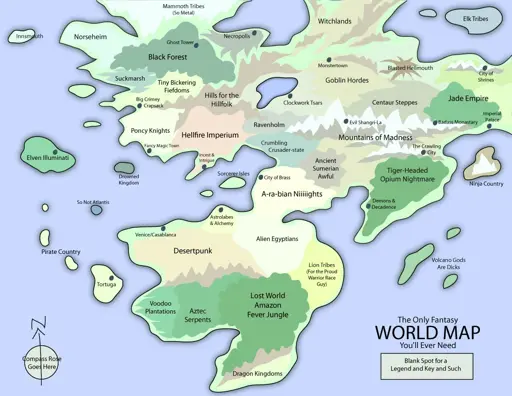
This map sadly looks like a completely functional and effective RPG campaign map - even without resorting to plot tropes in each of these locations, there’s just a lot of diversity and interesting influences from around the globe, and, if mindfully handled, that diversity can compensate for some of the stereotyping.
Why is that sad? Looks like a fun map.
-
It’s just a little dispiriting to acknowledge that you can make a better map by sticking to what you expect rather than by making a totally custom world. But I agree it looks super fun.
-
The biggest problem is most players aren’t paying attention and won’t remember everything.
If you do elves and dwarves, they’ll have some idea of what’s happening.
If you do the Wilfren and the Senderri, they won’t. Even if you explain it a dozen times. Even if you show them in a dozen scenes.
I may just have trauma from being in poorly fitting groups, but I think getting people to learn a bunch of your custom lore is always going to be a long shot.
If you make the world collectively, you’ll have a better chance of it working. But some players hate being creative like that.
I ran a group of new players in my home brew world, most of the ancestry names were changed. A few of them were taking notes, and even then they were tripping up over the names. I even found myself messing up a couple times. After 5 or 6 sessions I went back to elves and dwarves and things went a lot smoother.
-
The practice of using fantasy counterpart cultures - cultures and societies that are very similar to real world cultures of specific times and places - has a long history in fantasy in general, and fantasy RPGs in particular.
And, in truth, there are good reasons for that. Fantasy worldbuilding is a major task, and fantasy worldbuilding for RPGs in particular requires that not only the GM understands any given culture, but the players as well - but understanding a culture requires a lot of effort, and there is only so much time everyone at the table has available for that.
Thus, using familiar elements is a great time saver. The main reason we see the same Tolkien ancestries over and over again (elves, dwarves, halflings, orcs…) is that most players of fantasy RPGs are already familiar with their basic concepts, and thus only have to learn what is different from the norm. But you create fantasy ancestries from scratch, you need to convey all that information to the players.
The same applies to fantasy counterpart cultures - if you have a vague familiarity with the real world culture, then familiarizing yourself with a fantasy culture will be a lot easier.
However, there’s also a lot that can go wrong with using fantasy counterpart cultures. Misrepresentation is always a danger, especially with marginalized groups and if the developers did not consult with members of that culture. Likewise, if you are building a fantasy counterpart culture of a nation that has some ugly history, then you risk whitewashing that history.
So what are your thoughts? Do you like to have fantasy counterpart cultures in your settings, or do you prefer to avoid them? And what are some good examples of fantasy counterpart cultures done right?
This goes both as a GM or PC: I do not feel comfortable to play on culture references that I don’t know first hand. I have come to prefer playing humans only in my games. There are non human NPC folks in my games but they don’t mimick an existing culture. I have been playing The Dark Eye in a group and that has been cirngeworthy to me, seeing all these cultural references mashed together in Aventuria…
-
IMO the way to avoid this (as well as making it less cliched) is rather than having the likes of Chinaland, Vikingland and Egyptland, to instead blend disparate civilisations together into something that isn’t just copy of a single real culture.
Agreed. Egypt-but-with-Samurai-and-ninjas, Spain-but-in-Russia. It’s not even that hard once you start thinking thru what cultural factors could have cause that outcome logically and the differences from the multiple source cultures you’re blending that would arise as an outcome of the blend.
-
The practice of using fantasy counterpart cultures - cultures and societies that are very similar to real world cultures of specific times and places - has a long history in fantasy in general, and fantasy RPGs in particular.
And, in truth, there are good reasons for that. Fantasy worldbuilding is a major task, and fantasy worldbuilding for RPGs in particular requires that not only the GM understands any given culture, but the players as well - but understanding a culture requires a lot of effort, and there is only so much time everyone at the table has available for that.
Thus, using familiar elements is a great time saver. The main reason we see the same Tolkien ancestries over and over again (elves, dwarves, halflings, orcs…) is that most players of fantasy RPGs are already familiar with their basic concepts, and thus only have to learn what is different from the norm. But you create fantasy ancestries from scratch, you need to convey all that information to the players.
The same applies to fantasy counterpart cultures - if you have a vague familiarity with the real world culture, then familiarizing yourself with a fantasy culture will be a lot easier.
However, there’s also a lot that can go wrong with using fantasy counterpart cultures. Misrepresentation is always a danger, especially with marginalized groups and if the developers did not consult with members of that culture. Likewise, if you are building a fantasy counterpart culture of a nation that has some ugly history, then you risk whitewashing that history.
So what are your thoughts? Do you like to have fantasy counterpart cultures in your settings, or do you prefer to avoid them? And what are some good examples of fantasy counterpart cultures done right?
If you want a good shot at inventing novel civilizations and races, ask kids that are 3-6 years old. Whatever the hell they come up with, try to make it believable. See Axe Cop for a rough idea of what to expect.
-
The practice of using fantasy counterpart cultures - cultures and societies that are very similar to real world cultures of specific times and places - has a long history in fantasy in general, and fantasy RPGs in particular.
And, in truth, there are good reasons for that. Fantasy worldbuilding is a major task, and fantasy worldbuilding for RPGs in particular requires that not only the GM understands any given culture, but the players as well - but understanding a culture requires a lot of effort, and there is only so much time everyone at the table has available for that.
Thus, using familiar elements is a great time saver. The main reason we see the same Tolkien ancestries over and over again (elves, dwarves, halflings, orcs…) is that most players of fantasy RPGs are already familiar with their basic concepts, and thus only have to learn what is different from the norm. But you create fantasy ancestries from scratch, you need to convey all that information to the players.
The same applies to fantasy counterpart cultures - if you have a vague familiarity with the real world culture, then familiarizing yourself with a fantasy culture will be a lot easier.
However, there’s also a lot that can go wrong with using fantasy counterpart cultures. Misrepresentation is always a danger, especially with marginalized groups and if the developers did not consult with members of that culture. Likewise, if you are building a fantasy counterpart culture of a nation that has some ugly history, then you risk whitewashing that history.
So what are your thoughts? Do you like to have fantasy counterpart cultures in your settings, or do you prefer to avoid them? And what are some good examples of fantasy counterpart cultures done right?
Part of the fun of DMing for me is in homebrewing cultures…or, more accurately, homebrewing factions that have a culture.
Besides which, there are some fundamental flaws in your premises:
You assert that a counterpart culture is easier to understand than an original one. I 100% understand any culture I make up, definitionally. On the other hand, neither I nor anyone else at my table can say the same about any IRL culture. Even members of a given IRL culture can never fully understand the totality of it.
You also say
[if] you create fantasy ancestries from scratch, you need to convey all that information to the players.
And I don’t think that’s true. Players don’t need to know everything about a culture to interact with them. In many cases, the player characters are themselves unfamiliar with that culture, in which case any mystery, mistakes, miscommunications etc are valuable in-character roleplay. And when the PCs would be familiar with a relevant aspect of a given culture, you can simply tell them that detail, no need to loredump everything. (Eg “I beg for mercy” “Your character knows that The Southern Pirates are notorious for never taking prisoners, are you sure you want to try that?”)





Hello! It looks like you're interested in this conversation, but you don't have an account yet.
Getting fed up of having to scroll through the same posts each visit? When you register for an account, you'll always come back to exactly where you were before, and choose to be notified of new replies (either via email, or push notification). You'll also be able to save bookmarks and upvote posts to show your appreciation to other community members.
With your input, this post could be even better 💗
Register Login