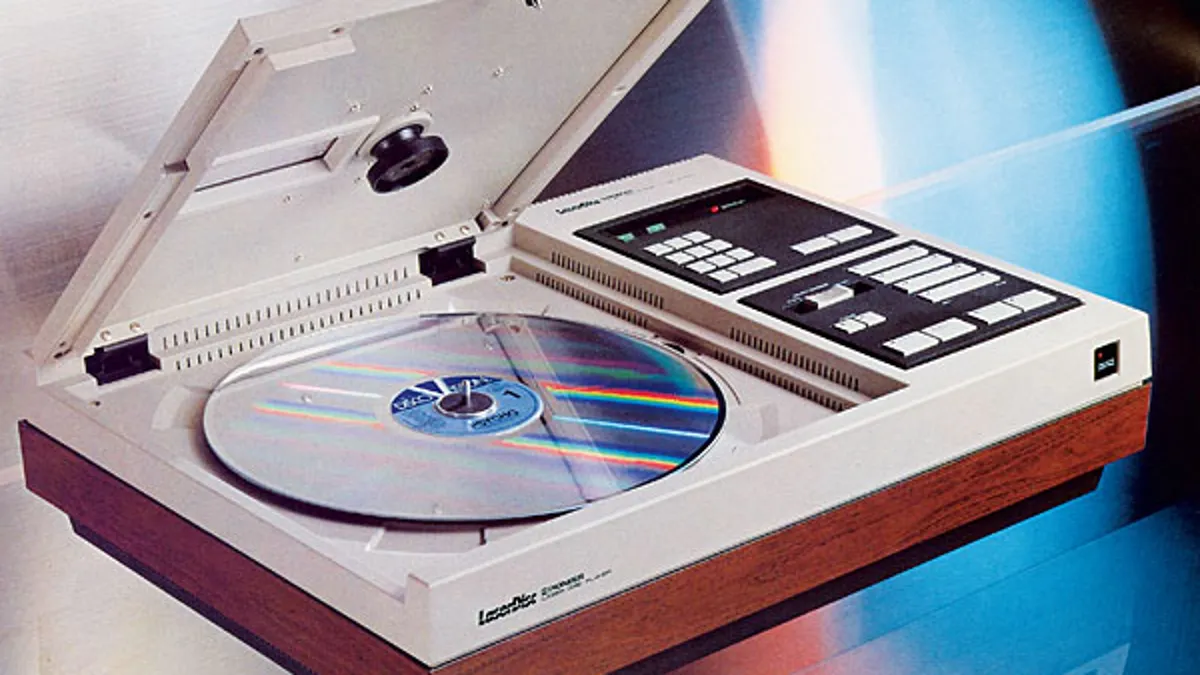
LaserDisc looks like a giant CD, but don’t let that fool you—it’s not digital.
-
LaserDisc looks like a giant CD, but don’t let that fool you—it’s not digital.
The picture on those discs is actually analog video, recorded as a frequency-modulated signal just like broadcast TV or VHS. Instead of storing pixels, the pits and lands on the disc encode continuous voltage changes. When you pop it into a player, the machine reads that FM signal and spits out plain old composite video—the exact same yellow RCA connection you’d get from a VCR.
Since it’s analog, LaserDisc doesn’t have a neat pixel count. There’s no “480p” baked in. Instead, sharpness depends on bandwidth, which works out to around 425 horizontal lines on NTSC discs. That’s miles ahead of VHS’s muddy 240, but nowhere near DVD’s clean digital precision. Which is why LaserDisc looks sharper and steadier than tape, yet still has those analog quirks—dot crawl, color bleed, and a bit of noise if you look closely.
Audio tells the same story. Early discs carried nothing but analog stereo FM tracks, while later ones layered in digital PCM for CD-quality sound. So you’d get crisp audio on top of video that was still fundamentally analog.
That’s what makes LaserDisc such an oddball—it’s futuristic optical tech on the outside, but inside, it’s pure broadcast-era television.
-
LaserDisc looks like a giant CD, but don’t let that fool you—it’s not digital.
The picture on those discs is actually analog video, recorded as a frequency-modulated signal just like broadcast TV or VHS. Instead of storing pixels, the pits and lands on the disc encode continuous voltage changes. When you pop it into a player, the machine reads that FM signal and spits out plain old composite video—the exact same yellow RCA connection you’d get from a VCR.
Since it’s analog, LaserDisc doesn’t have a neat pixel count. There’s no “480p” baked in. Instead, sharpness depends on bandwidth, which works out to around 425 horizontal lines on NTSC discs. That’s miles ahead of VHS’s muddy 240, but nowhere near DVD’s clean digital precision. Which is why LaserDisc looks sharper and steadier than tape, yet still has those analog quirks—dot crawl, color bleed, and a bit of noise if you look closely.
Audio tells the same story. Early discs carried nothing but analog stereo FM tracks, while later ones layered in digital PCM for CD-quality sound. So you’d get crisp audio on top of video that was still fundamentally analog.
That’s what makes LaserDisc such an oddball—it’s futuristic optical tech on the outside, but inside, it’s pure broadcast-era television.
@atomicpoet in 1983 I had a summer job in a video store that only had LaserDiscs. In St Vital, Winnipeg, I think on St Anne’s Road. The picture quality was good.
-
@atomicpoet in 1983 I had a summer job in a video store that only had LaserDiscs. In St Vital, Winnipeg, I think on St Anne’s Road. The picture quality was good.
Karen Keiller Yeah, the picture quality is still really good. Stunning on a CRT.
-
LaserDisc looks like a giant CD, but don’t let that fool you—it’s not digital.
The picture on those discs is actually analog video, recorded as a frequency-modulated signal just like broadcast TV or VHS. Instead of storing pixels, the pits and lands on the disc encode continuous voltage changes. When you pop it into a player, the machine reads that FM signal and spits out plain old composite video—the exact same yellow RCA connection you’d get from a VCR.
Since it’s analog, LaserDisc doesn’t have a neat pixel count. There’s no “480p” baked in. Instead, sharpness depends on bandwidth, which works out to around 425 horizontal lines on NTSC discs. That’s miles ahead of VHS’s muddy 240, but nowhere near DVD’s clean digital precision. Which is why LaserDisc looks sharper and steadier than tape, yet still has those analog quirks—dot crawl, color bleed, and a bit of noise if you look closely.
Audio tells the same story. Early discs carried nothing but analog stereo FM tracks, while later ones layered in digital PCM for CD-quality sound. So you’d get crisp audio on top of video that was still fundamentally analog.
That’s what makes LaserDisc such an oddball—it’s futuristic optical tech on the outside, but inside, it’s pure broadcast-era television.
@atomicpoet I thought it took until Blu-Ray to beat LaserDisc for quality of image. Is that statement of mine dependant on a bunch of specific situations (CRT not flat screen / subjective analysis / whoknowswhatelse) or is it valid if you squint and look at it correctly?
-
@atomicpoet I thought it took until Blu-Ray to beat LaserDisc for quality of image. Is that statement of mine dependant on a bunch of specific situations (CRT not flat screen / subjective analysis / whoknowswhatelse) or is it valid if you squint and look at it correctly?
@IanAMartin Here’s a comparison of LaserDisc vs. DVD:
https://youtu.be/50L1C9xakOY
To my eye, they’re pretty similar.
I think DVD has the obvious advantage due to physical size and disc storage.
Nevertheless, I collect LaserDisc. -
@IanAMartin Here’s a comparison of LaserDisc vs. DVD:
https://youtu.be/50L1C9xakOY
To my eye, they’re pretty similar.
I think DVD has the obvious advantage due to physical size and disc storage.
Nevertheless, I collect LaserDisc.@atomicpoet I see what you mean. For some colour, LaserDisc is more saturated (reds, pinks), but DVD saturates others (greens, yellows). DVD seems to have slightly less contrast, or at least more midtones and LaserDisc seems to have a bolder and snappier look. It’s a tough call.
Presumably, we had to go to BluRay to surpass LaserDisc/DVD is the point, with both being kind of a wash until then.
-
@atomicpoet I see what you mean. For some colour, LaserDisc is more saturated (reds, pinks), but DVD saturates others (greens, yellows). DVD seems to have slightly less contrast, or at least more midtones and LaserDisc seems to have a bolder and snappier look. It’s a tough call.
Presumably, we had to go to BluRay to surpass LaserDisc/DVD is the point, with both being kind of a wash until then.
@IanAMartin Yes. And what I mean is DVD was more precise and consistent than LaserDisc—which is in keeping with it being a digital format.
But to the eye, they’re pretty similar. So yes, Blu-Ray was way more of a colossal leap compared to DVD when it came to picture fidelity. -
@IanAMartin Yes. And what I mean is DVD was more precise and consistent than LaserDisc—which is in keeping with it being a digital format.
But to the eye, they’re pretty similar. So yes, Blu-Ray was way more of a colossal leap compared to DVD when it came to picture fidelity.@atomicpoet VHS and even Beta was pretty wobbly at times, so consistency was out the window with tape, compared to either disc formats. Yeah, I definitely see the appeal of those, and either LaserDisc or DVD could satisfy. DVD almost seems too cold in its consistency without having any clear advantages to LaserDisc; at least philosophically.
-
@atomicpoet VHS and even Beta was pretty wobbly at times, so consistency was out the window with tape, compared to either disc formats. Yeah, I definitely see the appeal of those, and either LaserDisc or DVD could satisfy. DVD almost seems too cold in its consistency without having any clear advantages to LaserDisc; at least philosophically.
@IanAMartin I’m actually watching a LaserDisc on a CRT right now (Barton Fink).
It is really sharp. Great colour too.
But at the same time, you can spot the artefacts from the FM. Compared to VHS, it’s subtle. I don’t mind it—that’s part of the analog charm.
Yet there’s a lot of people who can’t tolerate any artefacts at all.