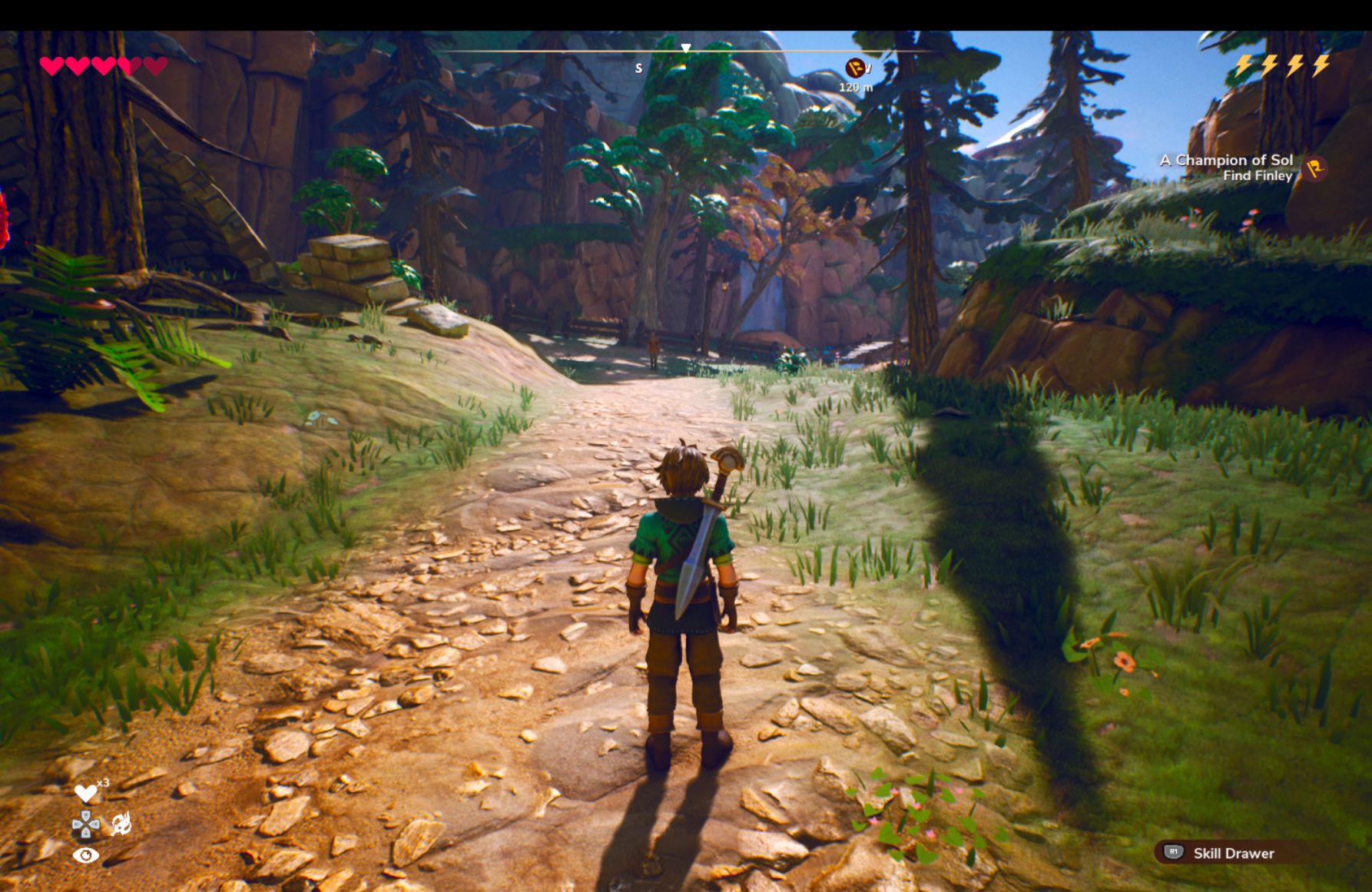
Oceanhorn 3 first impressions are that it really lived up to expectations.
I did not expect Apple to produce the best Zelda-like RPG this year. And while this was developed by Cornfox & Bros., Oceanhorn 3 got significant funding from Apple—and it’s now an exclusive for Apple Arcade.
So let me state emphatically: right now Oceanhorn 3 really is the best reason to subscribe to Apple Arcade. I’m not saying it’s worthwhile or that you should do it. But if you have a Mac, iPhone, iPad, or Apple TV—and you really want to game on these devices—Oceanhorn 3 is truly breathtaking.
Devs actually addressed my biggest complaint with Oceanhorn 2. The previous game didn’t have a dedicated jump button. This one does. Jumps are no longer contextual. You can jump to your heart’s content.
Visually, this is impressive. Since I’m playing on a MacBook Air M4, I can play at ultra high settings, and the level of detail on what amounts to a 5GB game is splendid. Of course, when not plugged in, my Mac complains about the power I’m consuming, so I opt for performance mode—and that’s pretty good too.
Sound design is equally excellent. The voice acting is crisp. The music is folksy and charming. And the sound effects sound lux on my MacBook.
Most impressive is the controls. Playing on a keyboard and mouse is intuitive and feels natural. Of course, you can connect a PlayStation controller to really give you a console-like experience. But what I love is how the game just naturally switches between gamepad and keyboard controls when you need to change controls. For example, if you need to use the touchpad, Oceanhorn will just tell you what the keyboard mapping is for other functions. Nice!
Now I’ve previously said this is the best Zelda-like RPG on offer this year, and I truly believe it. But I’ll go further: I like Oceanhorn 3 much more than Cloudheim. While Cloudheim is more graphically impressive and has the benefit of multiplayer, Oceanhorn 3 has a much more focused story with clearer objectives. Plus, I really enjoy hanging out in this unique world.
Usually, when I game on a Mac, I stream from my Alienware gaming PC via Steam Link. This gives me access to a much bigger library, and I can take advantage of my RTX 3090. But this is the first time in awhile where I feel that a Mac can truly be a good gaming platform on its own.
Oceanhorn 3 is superb. A few more Mac games like this, and maybe gaming won’t feel second class on a Mac. You would think. I’m still not optimistic, but we’ll see.